


Weekly GTA Housing Market Brief
Buyers Are Waiting, the Job Market Blinked,
and Fixed Rates Won't Stop Climbing.
Sunday, October 11, 2026 · Peter Kiriazopoulos, Kompass Realty Group
5,040 GTA home sales in September (−9% YoY) | $1,006,409 average GTA selling price (−5.1% YoY) | −68K Canadian jobs lost in September | 5.14% BMO's standard 5-year fixed rate after Oct 7 hike |
Welcome back. Here's the frame I'd use heading into the week: last Sunday I told you the first read on September pointed to a stalemate. The official numbers are in, and they agree. But the bigger surprise came on Friday, when Statistics Canada reported that the economy lost another 68,000 jobs.
That matters for housing in a specific way. Rising fixed mortgage rates have been the story for six weeks. Now buyers in Markham, Stouffville, Richmond Hill, Vaughan, Newmarket, Scarborough and Toronto are being asked to take on a bigger payment at a moment when job security is less certain. Hesitation is the rational response, and it shows up in every number below.
This Week at a Glance
Indicator | Latest | Prior / context | Read |
GTA home sales, Sept (TRREB) | 5,040 (−9% YoY) | 5,057 (−2.1%, Aug) | Sales slid again |
GTA new listings, Sept | 16,500 (−14.4% YoY) | −14.1% (Aug) | Fresh supply pulling back |
GTA average price | $1,006,409 (−5.1%) | $993,410 (Aug) | Up on Aug, down on last year |
MLS HPI composite benchmark | −4.7% YoY | n/a | Typical home still softer |
GTA condo avg / sales | $605,257 / 1,316 | −7.7% / −7.8% YoY | Weakest segment |
Canada jobs, Sept | −68,000 | −42,000 (Aug) | Two straight losses |
Unemployment rate | 6.5% | 6.4% (Aug) | Participation 64.8%, 29-yr low |
BoC hike odds, Oct 28 | ~25–40% | ~59% (Sept 25) | Hold now favoured |
5-yr GoC yield / best 5-yr fixed | ~3.56% / ~4.24–4.34% | 3.73% high (Sept 28) | Yields eased, lenders still rising |
1. TRREB Confirms It: Listings Fell Faster Than Sales, and Prices Still Slipped
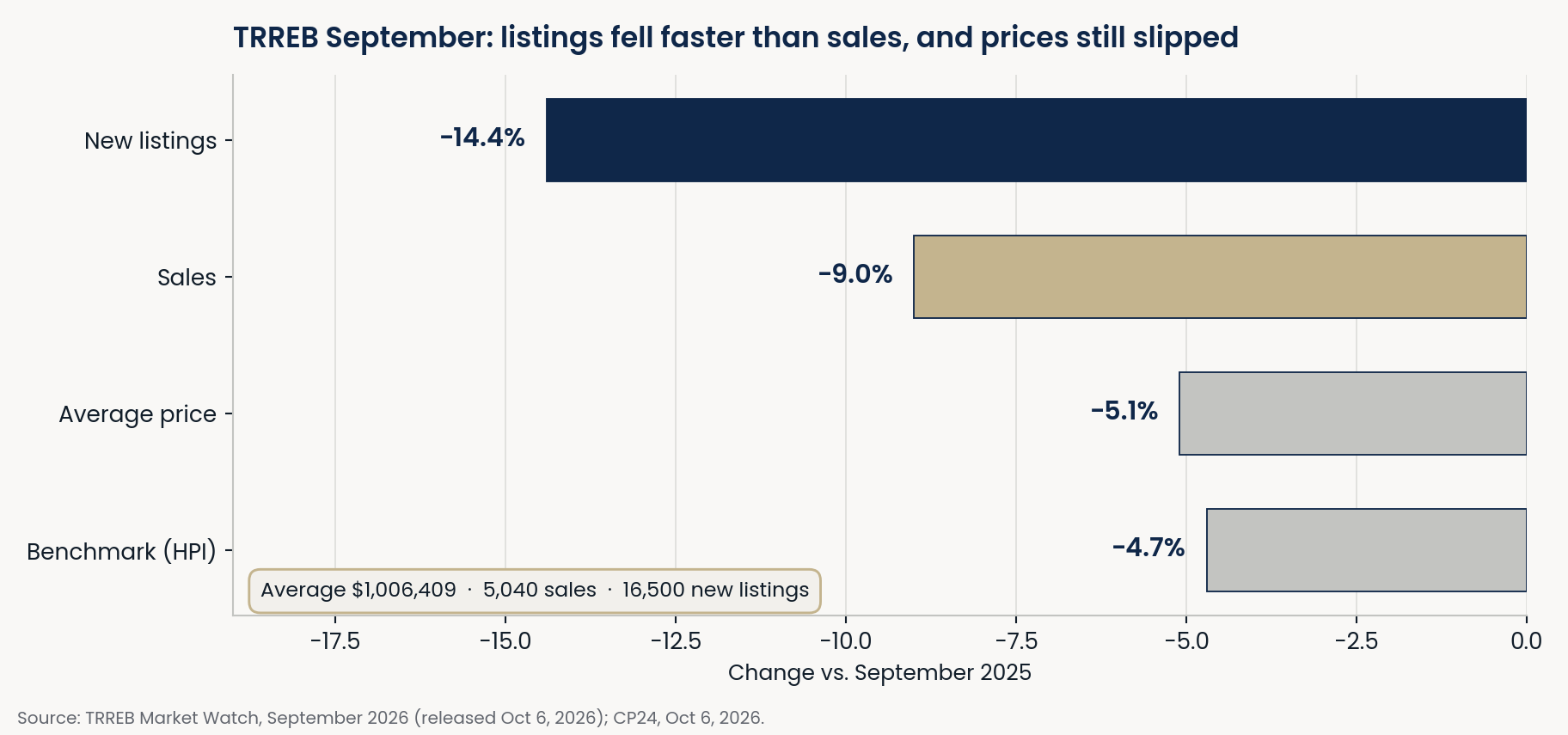
The Toronto Regional Real Estate Board released its September Market Watch on Tuesday: 5,040 sales, down 9% from a year ago, on 16,500 new listings, down 14.4%. The average selling price was $1,006,409, down 5.1% from $1,060,036, and the MLS HPI composite benchmark was down 4.7%. It lines up closely with John Pasalis's early read at Move Smartly, which I covered last week, so the signal is now consistent across two data sets.
The framing from TRREB is that buyers are in a holding pattern. Economic, inflation and borrowing-cost uncertainty are weighing on decisions, and the renewed trade tensions with the U.S. and higher gas prices are not helping. Broker Cailey Heaps notes that ultra-luxury and first-time buyers are still active, while move-up buyers are mostly staying out because of job worries. That last point is worth sitting with: move-up buyers are the people who sell a Markham or Vaughan townhouse to buy a detached home, and when they pause, the whole chain slows down.
Supply is easing, not vanishing. Fresh listings are pulling back as sellers who don't have to sell choose to wait, and the active pool is still sizable, so buyers still have genuine choice. Because demand is easing at the same time, it hasn't turned into higher prices. By property type, the average detached price fell about 5%, townhouses about 4.6% and semis were roughly flat, while condos fell the most.
Buyers aren't gone. They're waiting for a reason to move, and right now the news isn't giving them one. |
There's an interesting side note from TRREB's president: with Toronto's municipal election on October 26, housing affordability, supply and the cost of buying a home are shaping up as top voter issues. Whatever the outcome, municipal policy on approvals and fees will influence the next four years of supply.
2. Condos: Two-Thirds Sold Under $600K, and the 905 Is Falling Fastest
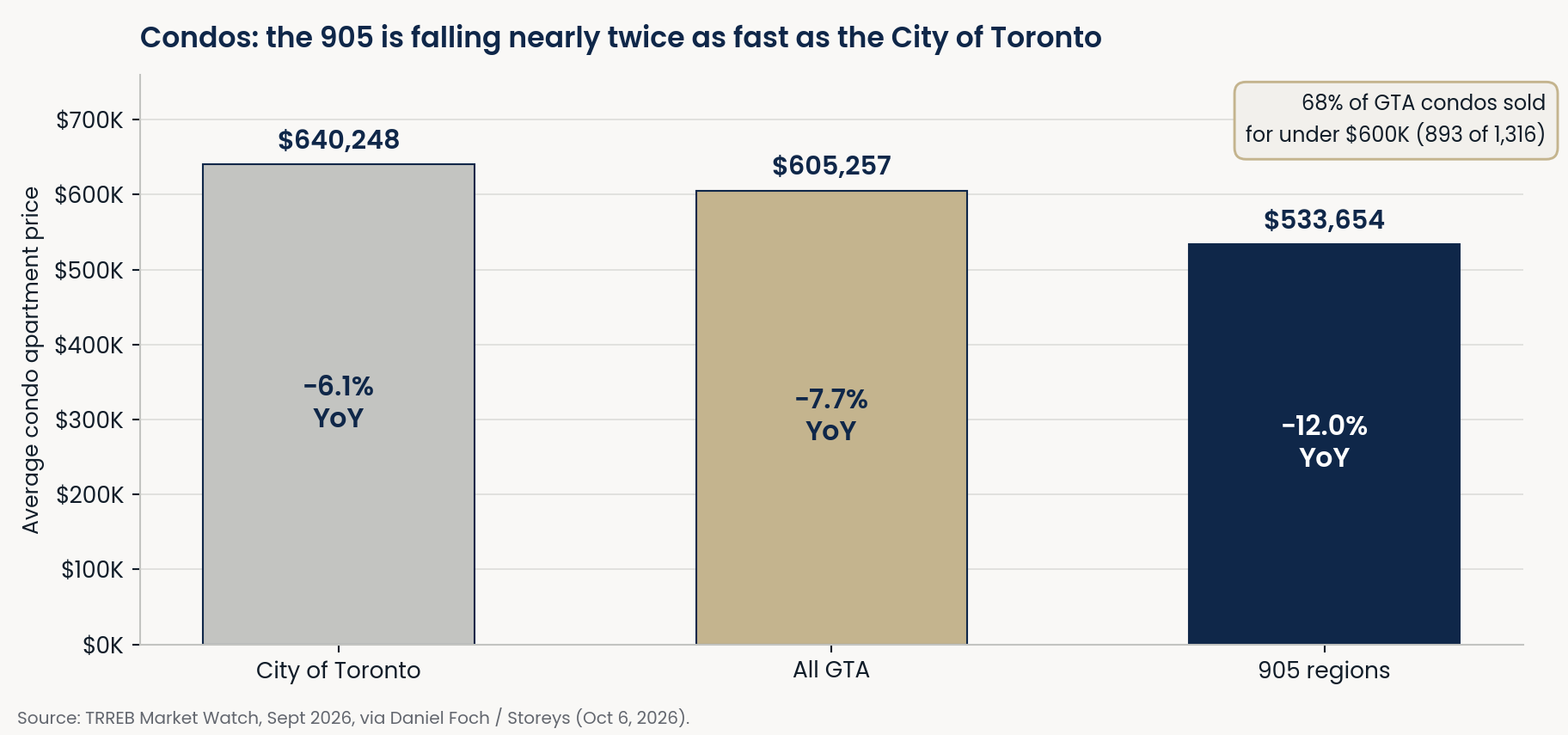
Daniel Foch's breakdown of the TRREB data for Storeys shows the condo market in detail. There were 1,316 condo apartment sales in September, down 7.8%. The average price was $605,257, down 7.7%, the steepest decline of any housing type. About 68% of sales (893) were under $600,000, and 45% (594) were under $500,000.
The geographic split is the part most headlines miss. In the City of Toronto, 884 condos sold at an average of $640,248, down 6.1%. In the 905 regions, 432 sold at $533,654, down 12%, on a 12.4% drop in sales. Month-end listings work out to about 6 per sale in Toronto and 6.7 per sale in the 905, which gives buyers more leverage in places like Scarborough's edges, Markham, Vaughan and Richmond Hill's newer towers. BNN Bloomberg also ran a segment this week with Pasalis on condo prices touching a six-year low.
What I'd tell each side: buyers should treat the 905 condo market as a negotiation, with inspection, status certificate review and financing conditions all back in play. Sellers should price against recent sales, not asking prices, because the gap is wide. Investors should remember that a lower purchase price only helps if the rent covers a mortgage that is getting more expensive, not cheaper. A bottom may be forming, but it is a process, not an event.
3. Canada Lost 68,000 Jobs, and the October Rate Hike Odds Dropped
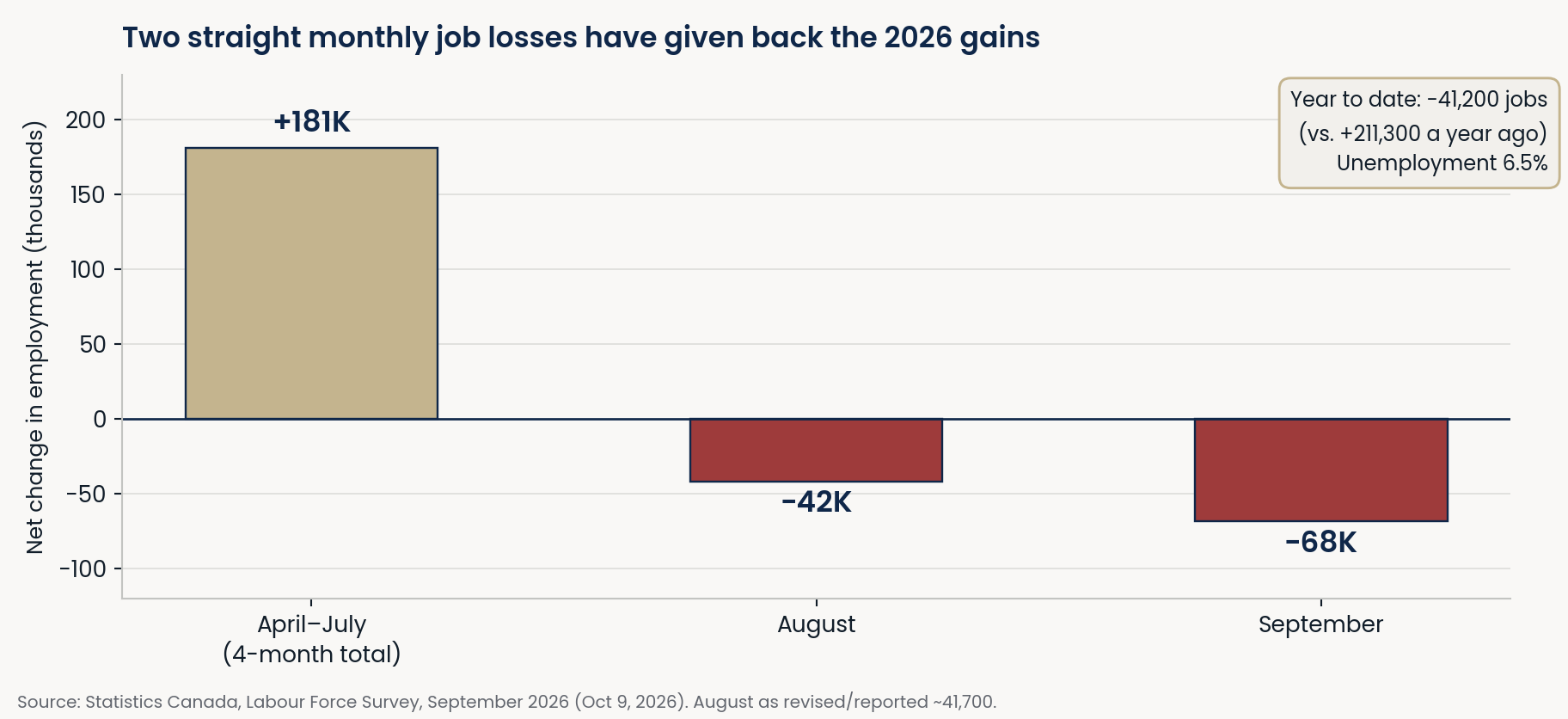
Statistics Canada's September labour force survey, released Friday, showed a net loss of 68,000 jobs after a loss of about 42,000 in August. Economists polled by Reuters had expected a small gain of about 9,000. The unemployment rate rose to 6.5% from 6.4%, and the participation rate fell to 64.8%, its lowest in 29 years outside the pandemic. Year to date, Canada is down about 41,200 jobs compared with a gain of 211,300 over the same period last year. Ontario lost about 20,000 jobs in the month. Youth employment fell by 48,000, and the losses were concentrated in education, health and social assistance and manufacturing.
Wage growth ticked up to 2.3%, so this is not a story of collapsing pay. It's a story of a softening labour market while energy prices keep inflation elevated, which is the awkward mix the Bank of Canada has been worried about. Desjardins' Royce Mendes says the weak report makes an unchanged rate more likely on October 28, though higher energy prices feeding into other categories could still force tighter policy later. TD's Andrew Hencic expects unemployment to tread water as trade friction and higher rates weigh on activity.
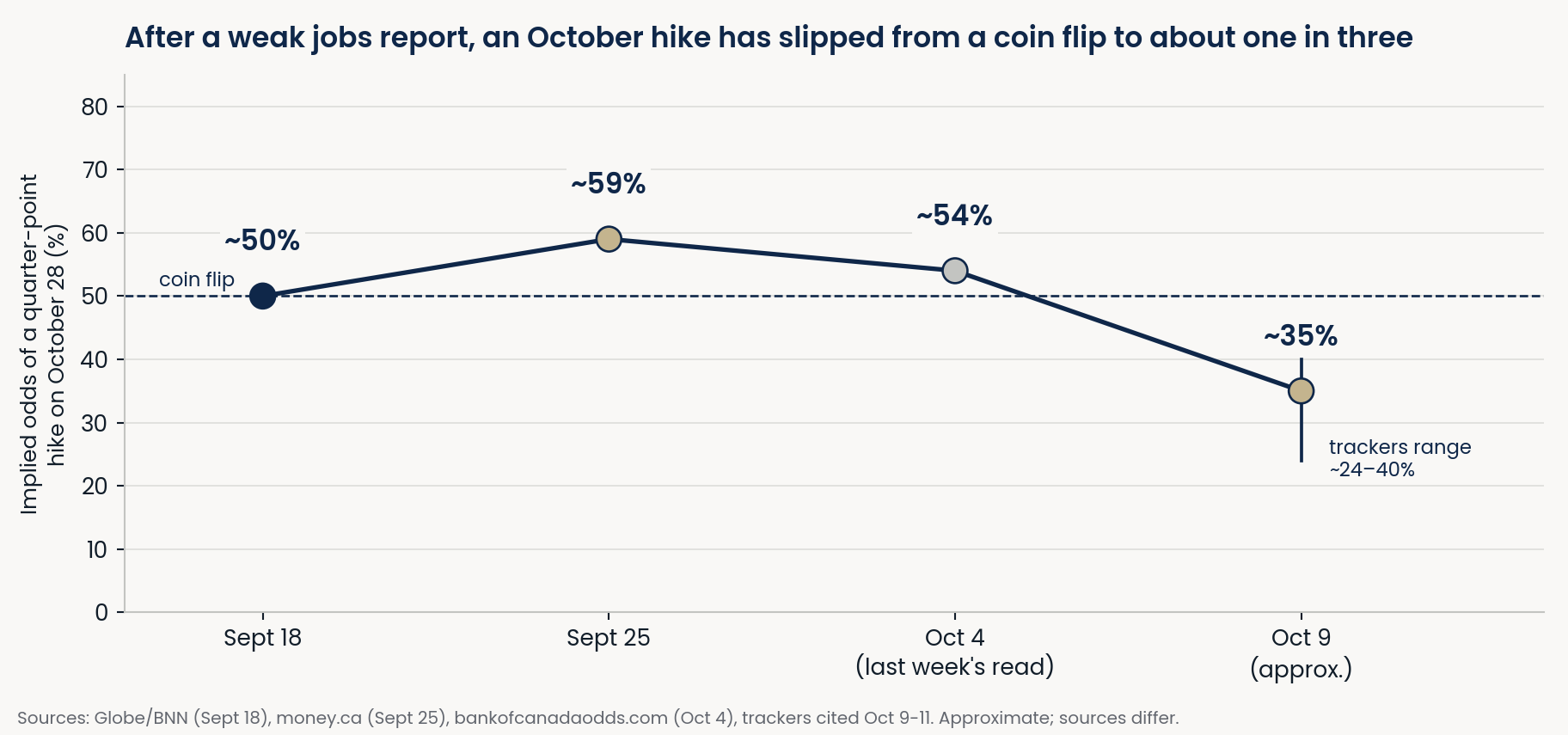
Where does that leave the market's pricing? Odds of a quarter-point hike on October 28 peaked near 59% in late September, were closer to one in three by the first days of October, and sit roughly in the 25% to 40% range depending on the tracker I checked. Sources disagree, so please treat that as a range, not a single number. Several outlets now say traders expect a move in December instead, and one research note calls for a hold on the 28th and a hike by Christmas. The next catalyst is September CPI on October 19.
4. Fixed Rates Are Still Rising Even Though Bond Yields Backed Off
Here's something that surprises many homeowners: fixed mortgage rates follow Government of Canada bond yields, not the Bank of Canada's overnight rate, and the lenders are slower to cut than to raise. The five-year yield touched a 52-week high near 3.73% on September 28 before easing to about 3.56% after the jobs report. But all six of the big banks have raised some fixed rates since early September.
The most recent moves: BMO raised its standard five-year fixed by 20 basis points to 5.14% and its special three-year to 4.94% on October 7. CIBC raised its one- to four-year fixed rates by 15 basis points and its five-year by 20 on October 9. RBC raised its one- to five-year terms by 10 to 20 basis points earlier in the month, and Scotiabank's advertised two-year is now 5.14%. Among discount lenders, the best insured five-year fixed has moved from 4.09% at the end of August to roughly 4.24% to 4.34% depending on the lender and down payment, with the best five-year variable around 3.25% to 3.40% and prime unchanged at 4.45%.
CMHC estimates about 1.15 million mortgages renew in 2026 and another 940,000 in 2027. If your renewal is in the next four to six months, the bond-yield pullback may give some relief, but I wouldn't count on it. Get quotes from your bank and from a broker, ask for a written rate hold, and don't assume your lender's renewal letter is its best offer.
Peter's Take
Here's how I'm reading it. For six weeks, buyers have been asked to absorb higher fixed rates, a trade fight with the U.S. and a stubborn oil price. This week they were handed a weaker job market too. The market's response is not panic. It's patience. Patient buyers and reluctant sellers produce a quiet market, and quiet markets reward preparation.
If you're buying: the leverage is yours, especially on condos in the 905 and on homes that have sat more than a few weeks. Secure a written rate hold, keep your conditions, and make sure your payment still works if rates move another quarter point. If your job feels less certain than it did in the spring, say so to your mortgage broker early.
If you're selling: price to what sold in the last 60 days, not to spring. Fewer competing listings help, but they don't guarantee a premium when buyers are cautious. Presentation, pricing and timing matter more than they have in years.
If you're investing: underwrite at today's rates plus a hike, and assume longer vacancy and more incentives. Lower prices help your entry point, but a weaker job market also hits tenant demand.
What to watch next: September CPI on October 19; CMHC September housing starts in mid-October; the Toronto municipal election on October 26; and the Bank of Canada's October 28 decision and new forecast. If you'd like to talk through what this means for your street, price range or renewal date, reach out. That conversation is always more useful than the general one.
Sources
• TRREB - Market Watch, September 2026 (released October 6, 2026): trreb.ca/wp-content/files/market-stats/market-watch/mw2609.pdf
• CP24 / The Canadian Press - "Rising mortgage rates, tariff tensions weigh on Greater Toronto September home sales," October 6, 2026: cp24.com/local/toronto/2026/10/06/greater-toronto-home-sales-in-september-down-from-year-ago-average-price-also-lower/
• Storeys (Daniel Foch) - "Two Thirds Of GTA Condos Sold For Less Than $600K In September," October 6, 2026: storeys.com/gta-condos-trreb-market-watch/
• BNN Bloomberg - "Toronto condo prices hit six-year low" (John Pasalis), October 6, 2026: bnnbloomberg.ca/video/shows/the-street/2026/10/06/toronto-condo-prices-hit-six-year-low/
• Statistics Canada - Labour Force Survey, September 2026 (October 9, 2026); coverage: CBC, Globe and Mail, The Hub (thehub.ca/2026/10/09/canada-shed-68000-jobs-in-september-statistics-canada-reports/), Advisor.ca
• BNN Bloomberg - "Canada's 2026 job gains have been erased," October 9, 2026 (Desjardins' Royce Mendes): bnnbloomberg.ca/business/economics/2026/10/09/canadas-2026-job-gains-have-been-erased-the-hardest-hit-area-wasnt-the-one-facing-us-tariffs/
• Finimize - "Canada's September Job Report Landed With A Thud" (TD's Andrew Hencic), October 2026: finimize.com/content/canadas-september-jobs-report-put-the-boc-in-focus
• Bank of Canada odds trackers (bankofcanadaodds.com, insightfinance.ca, thenorthledgermoney.substack.com), accessed October 10-11, 2026; figures approximate and sources differ
• Big-bank fixed-rate increases (BMO Oct 7, CIBC Oct 9, RBC, Scotiabank): money.ca; nesto.ca; Ratehub.ca; WOWA.ca, as of October 9-10, 2026
• Move Smartly (John Pasalis) - "GTA Home Sales Slow Again in September," October 2, 2026 (referenced from last week's brief)
• CMHC - mortgage renewal estimates (1.15M in 2026; 940,000 in 2027), as cited by nesto.ca / money.ca, October 2026
Peter Kiriazopoulos, Sales Representative · Kompass Realty Group · RE/MAX Ultimate Realty Inc., Brokerage · 1739 Bayview Avenue, Toronto
This brief is provided for general information only and is not intended as financial, mortgage, legal or tax advice. Market data is sourced as cited above and is subject to revision. Not intended to solicit buyers or sellers currently under contract with another brokerage.