

Weekly GTA Housing Market Brief
The Number That Scared Everyone Was Already Reversing —
and the Second Half of 2026 Just Got More Interesting.
Sunday, June 22, 2026 · Peter Kiriazopoulos, Kompass Realty Group
3.2% May CPI inflation — but almost all gasoline | US$78 Brent crude — lowest since early March | $702K national avg price — first above $700K in 23 mo. | ~4.0% best 5-yr fixed (variable ~3.35%) |
Welcome back. If you only saw one housing headline this week, it was probably the scary one that landed this morning: Canada's inflation rate jumped to 3.2% in May, up from 2.8% in April. On its face, that's the kind of number that kills rate-cut hopes. But read past the headline and the story actually flips — because of what was driving it, and what has already happened to that driver since.
Here's the frame I'd use. That 3.2% was almost entirely gasoline — and the oil price behind the pump has already cratered roughly 20% on a U.S.–Iran deal to reopen the Strait of Hormuz. So the inflation print is a backward-looking snapshot of a spike that's already reversing, while the Bank of Canada's core measures never left 2%. Net of all of it, the case for a rate cut later this year quietly got stronger this week, not weaker. Underneath the macro, the GTA is still running at two speeds: freehold in Markham, Richmond Hill, Stouffville and Newmarket is firming, while the downtown Toronto and Scarborough condo market stays stuck. Let's get into it.
1. Inflation Hit 3.2% — but It Was a Gas Story, Not an Everything Story
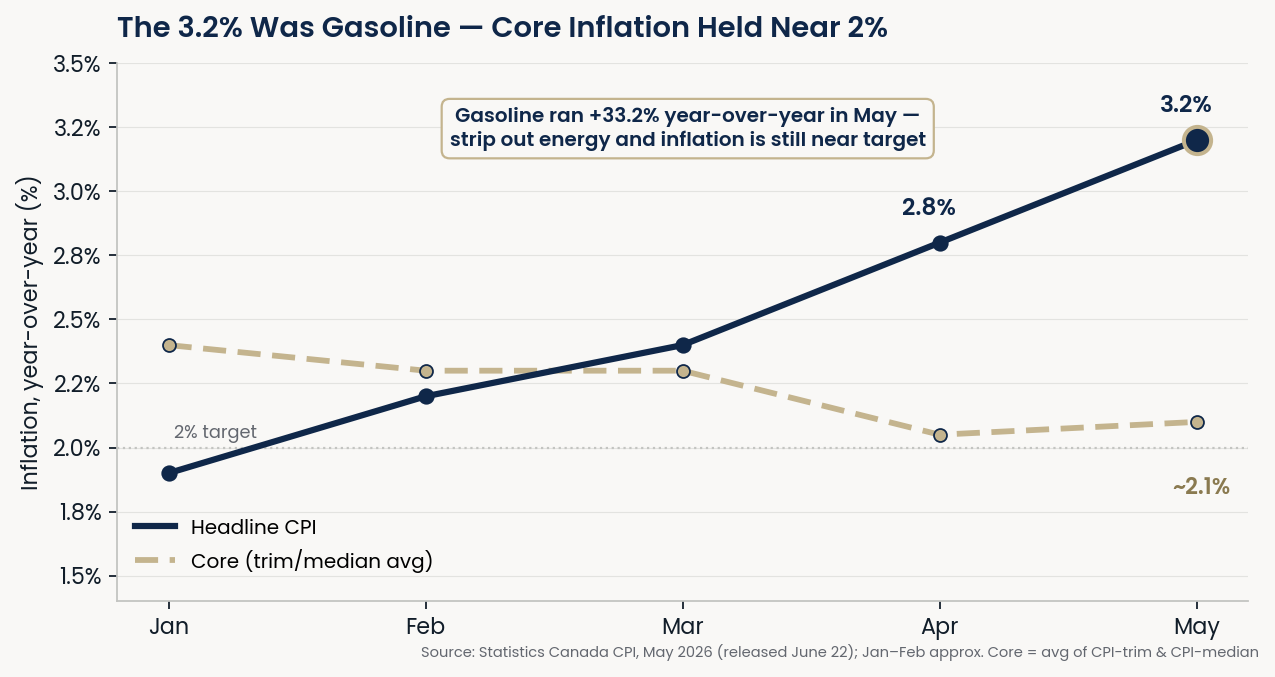
Statistics Canada released the May Consumer Price Index this morning, and the headline number climbed to 3.2% year-over-year, up from 2.8% in April, with prices up 0.5% on the month. That's the third straight month inflation has accelerated, and it's the loudest the number has been in a while. Taken alone, it reads like a problem for anyone hoping for lower rates.
But the anatomy matters. The single biggest driver was gasoline, which ran 33.2% higher than a year ago — up from a 28.6% gain in April — as the spring oil shock worked its way to the pump. Food bought from stores rose 4.3%, the sixteenth straight month groceries have outpaced headline inflation, which is real and it stings. But the measures the Bank of Canada actually steers by — its core CPI-trim and CPI-median — stayed close to 2%. Strip out energy and the underlying trend simply isn't running hot. This was also the release where StatCan rolled in its updated 2025 spending basket, so the weightings shifted a touch too.
My read: don't let one gas-soaked headline rewrite the whole story. A 3.2% print built on a 33% jump in gasoline tells you about the price of oil last month — not about broad, sticky inflation in the economy. And as the next section shows, that oil price has already moved hard in the other direction.
2. The Oil That Caused It Has Already Cratered — Reopening the Cut Path
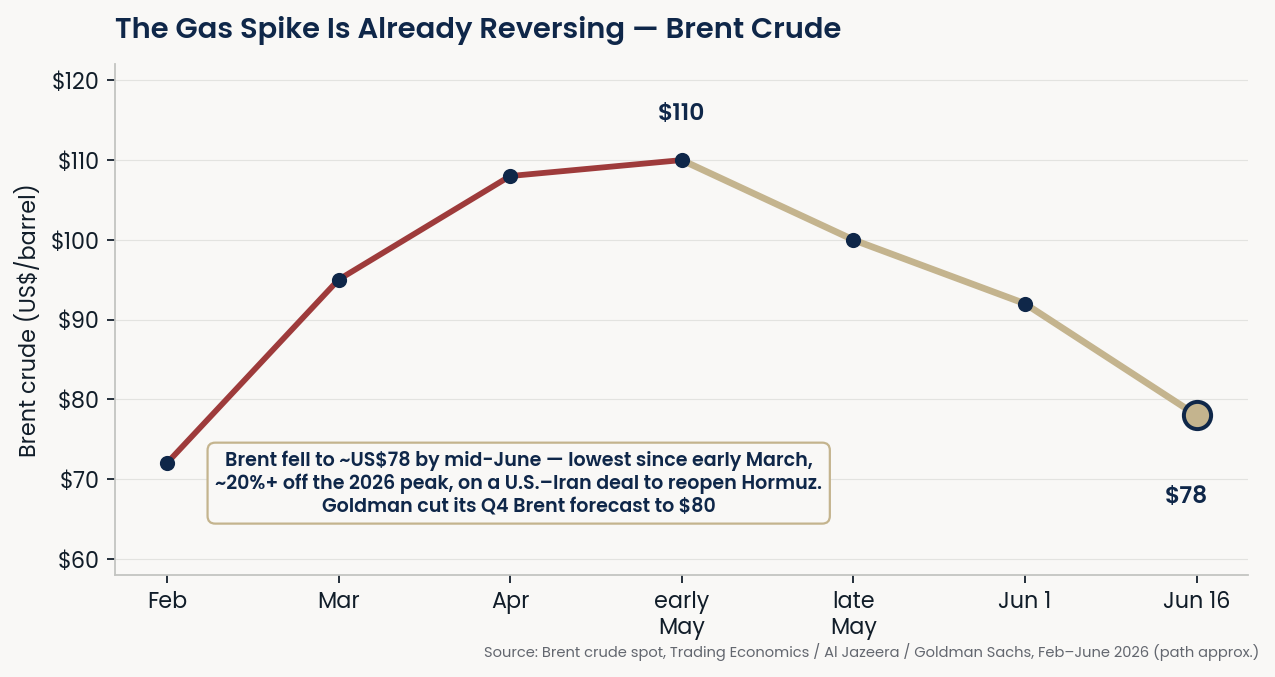
This is the part the inflation headline can't capture, because CPI looks backward and oil markets look forward. Through the spring, Brent crude spiked toward US$110 a barrel on the Middle East conflict — that's the surge that drove May's gasoline number. But over the past two weeks it has fallen off a cliff. Brent dropped to around US$78 by mid-June, its lowest level since early March and more than 20% below the 2026 peak. The catalyst: a framework deal to end the U.S.–Iran war and reopen the Strait of Hormuz, with the U.S. lifting its blockade of Iranian ports in exchange. Goldman Sachs was confident enough to cut its Brent forecast to $80 for the fourth quarter, down from $90, and now expects Persian Gulf exports back to pre-war levels by the end of July.
Why this matters for your mortgage: oil was the main thing standing between the Bank of Canada and a rate cut. If energy keeps cooling, June and July inflation should drift back down, and the case for a fall rate cut comes back to life. The Bank's next decision is July 15. Markets still expect a hold that day — and it's genuinely not a done deal that oil stays down: the framework still needs to hold, and even a signed agreement leaves real work before crude fully normalizes. So treat the optimism with a pinch of salt. But the direction has clearly flipped from where it sat just a month ago, and that's the freshest signal on the board.
One caveat for anyone shopping a mortgage right now: a Bank of Canada cut would help variable rates first, not fixed. Variable moves with the Bank; fixed tracks government bond yields, which have stayed elevated — the 5-year Government of Canada yield is hovering around 3.1%. That's why the best 5-year fixed is sitting near 4.0% (insured), with the Big Six closer to the high-4s, while the best variable is around 3.35%. If the cooling-oil, lower-rate story plays out, variable-rate holders and anyone facing a near-term renewal are the first to feel the relief.
3. Underneath the Noise, the Market Quietly Firmed in May
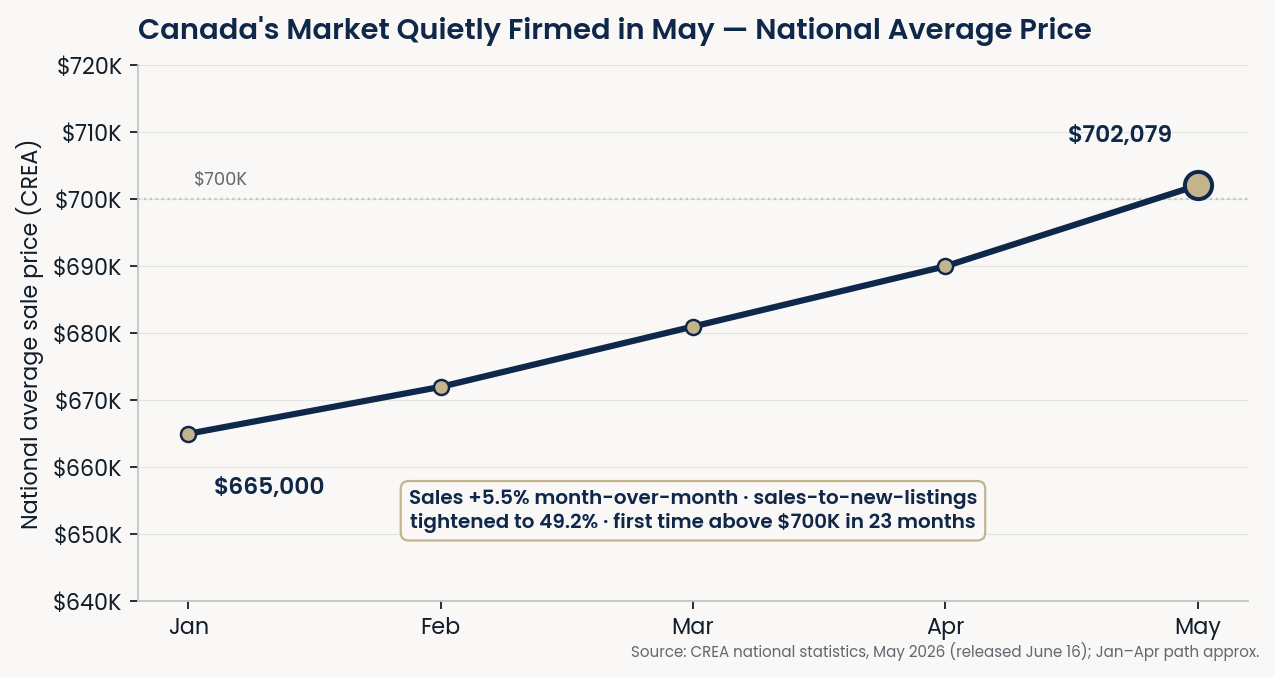
Step away from the macro drama and look at what buyers and sellers actually did, and the picture is steadier than the headlines suggest. CREA's national numbers, out Monday, showed home sales up 5.5% month-over-month in May, with the national average price rising to $702,079 — up 1.5% from a year ago, the highest in two years, and the first time the average has tipped above $700,000 in 23 months. The national sales-to-new-listings ratio tightened to 49.2% from 46.2% in April. That's a market finding its feet, not falling.
The GTA tells the same story from a different angle. The latest board data — TRREB's May report — had sales up 6.3% year-over-year while new listings fell almost 19%. Yes, the average GTA price is still down about 4.6% from a year ago, but that's the wrong number to fixate on: within 2026, the GTA average has climbed steadily from roughly $969,000 in January to about $1.07M in May. Demand rising into supply that's starting to pull back is the textbook setup for a market that's quietly tightening — and you can see it most clearly in York Region freehold, where detached and townhomes in Markham, Richmond Hill, Stouffville and Newmarket keep finding buyers.
I'll keep this honest, the way the analysts I read do — John Pasalis and Steve Saretsky have both stayed deliberately cautious, and they're right to. Trade-war uncertainty is real, and there's still a sizable backlog of inventory sitting on the market, so this is a gradual tightening, not a switch flipping to a seller's market. There's plenty of choice out there. But the direction of travel — firmer sales, fewer fresh listings, prices grinding up within the year — has pointed the same way for a full quarter now.
4. The Condo Market Is Still Stuck on a Different Clock
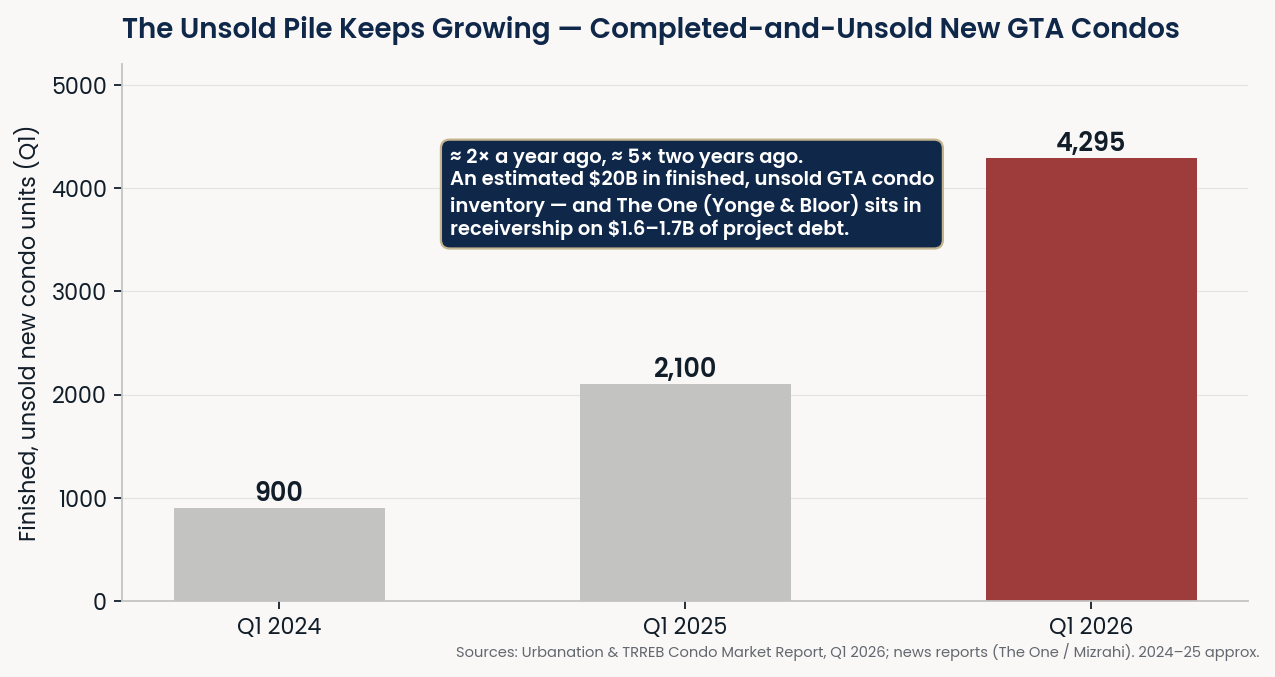
Now the other speed. While freehold firms up, the condo segment is still digging out from a glut, and the weight of it is staggering. A record 4,295 newly completed condos sat unsold as of the first quarter — roughly double a year ago and nearly five times the level of two years ago, part of an estimated $20 billion in finished-but-unsold GTA condo inventory. Unsold units in projects still under construction hit a nine-year high, and for the first time in at least three decades there were zero new project launches in the quarter.
The distress isn't abstract. The flagship example is The One at Yonge and Bloor, where Mizrahi Developments defaulted on $1.23 billion in loans, with total project debt reported at $1.6–1.7 billion — the most significant developer insolvency of the cycle. Across the segment, benchmark resale condo prices are down about 10% year-over-year and roughly 25% from the 2022 peak, leaving a record 38% gap between what developers ask for new units and what resale trades for. Some builders are cutting to or below cost; others are cancelling presales and converting thousands of units to rental. Institutional money — the $1.3B High Art Capital fund and Jesta's bulk buys — is slowly stepping in to absorb inventory, and RBC and TD both frame this as a long correction with stabilization on the horizon, not a snap-back.
What it means: the condo correction and the freehold recovery are two different markets on two different clocks. For buyers, entry-level pricing in downtown Toronto and Scarborough condos hasn't been this negotiable in years. For sellers and investors, it's a reality check: a resale condo today competes directly with deeply discounted new supply, so pricing sharply and presenting well on day one isn't optional.
Peter's Take
If you're buying
Don't let this morning's 3.2% headline scare you out of the market — it's a gas number, and the gas is already coming down. The more useful signal is that freehold supply is slowly drawing down while demand firms, which means the buyer-friendly window of this year (lots of listings, patient sellers, conditions back in your favour) is gradually narrowing, especially for detached and townhomes in Markham, Richmond Hill, Stouffville and Newmarket. There's still real choice, so no need to panic — but the supply math is starting to work against the "wait for lower" bet on freehold. If you're shopping with a variable rate or a near-term renewal, the cooling-oil story is quietly on your side. And condos in downtown Toronto and Scarborough remain the genuine value play— real negotiating room against discounted new inventory. Get pre-approved on both fixed and variable, and lean on the last 30 days of comps.
If you're selling
Easing competition on the listing side is starting to work in your favour — but mostly in the freehold lane. A well-prepared detached or townhome in York Region is meeting a market that's firming, with somewhat fewer fresh rivals than earlier this spring; price it to meet the market on day one and you can ride that momentum. If you're selling a condo, the playbook is different — you're up against brand-new units selling below cost, so sharp pricing and standout presentation carry the day. In both lanes, time on market is still the enemy.
If you're investing
Let the two-speed market be your map. Freehold across the 905 is the sturdier long-hold thesis — land, scarcity and end-user demand, with supply now beginning to tighten. Pre-construction condos remain broken on cash flow and appraisal risk. But resale condos in the 416 and Scarborough at today's reset prices can finally pencil for a patient landlord with a real down payment— and if the Bank does start cutting later this year, today's negotiated entry looks even better in hindsight. Cap rates, not capital gains. Run the actual numbers before you commit.
The bottom line this week: a loud inflation number arrived the same week the thing that caused it quietly fell apart — and that combination tilts the second half of 2026 a little more in buyers' and owners' favour, not less. Two near-term markers will tell us whether this is a real turn: the next Bank of Canada decision on July 15, and the June inflation and TRREB numbers in early July. Pair a possibly-reopening cut path with a GTA freehold market that's been firming since winter and a condo market handing buyers leverage, and you get a second half with opportunity on both sides of the split. The clients who win it will be the ones who know which of the two markets they're actually standing in.
— Peter
Sources
• Statistics Canada — “Consumer Price Index, May 2026” (headline 3.2%, gasoline +33.2%, updated basket), June 22, 2026 — https://www150.statcan.gc.ca/n1/daily-quotidien/260622/dq260622a-eng.htm
• CBC News — “Canada’s inflation rate rose to 3.2% in May, driven — again — by high gas prices”, June 22, 2026 — https://www.cbc.ca/news/business/cpi-may-2026-9.7244063
• CREA — “Canadian home sales jump in May 2026” national statistics (avg $702,079; sales +5.5% MoM), June 16, 2026 — https://stats.crea.ca/en-ca/
• Zoocasa — “Sales Increase 5.5% in May 2026, According to CREA” — https://www.zoocasa.com/blog/canada-home-sales-increase-may-2026-crea/
• Al Jazeera — “Oil prices continue slide amid hopes for peace, opening of Strait of Hormuz”, June 17, 2026 — https://www.aljazeera.com/economy/2026/6/17/oil-prices-continue-slide-amid-hopes-for-peace-opening-of-strait-of-hormuz
• Goldman Sachs / Reuters — “Goldman cuts Brent forecast to $80 for 2026, $75 for 2027 on Hormuz deal”, June 16, 2026 — https://investinglive.com/commodities/goldman-cuts-brent-forecast-to-80-for-2026-75-for-2027-on-hormuz-deal-20260616/
• Bank of Canada — “Bank of Canada maintains the policy rate at 2¼%”, June 10, 2026 — https://www.bankofcanada.ca/2026/06/fad-press-release-2026-06-10/
• Ratehub — Best 5-year fixed & variable mortgage rates, June 2026 — https://www.ratehub.ca/best-mortgage-rates
• TRREB — “Spring Home Sales Stronger Than Last Year” (Market Watch, May 2026) — https://trreb.ca/spring-home-sales-stronger-than-last-year/
• Move Smartly (John Pasalis) — Toronto real estate data & monthly market commentary, June 2026 — https://www.movesmartly.com/articles
• Steve Saretsky — Vancouver/Canada housing & macro commentary, June 2026 — https://stevesaretsky.com/
• Urbanation — “Slowest Condo Market in Over 30 Years Causing Construction to Collapse” (4,295 unsold; record gap) — https://www.urbanation.ca/news/slowest-condo-market-over-30-years-causing-construction-collapse
• RBC Economics — “Navigating Toronto’s frozen pre-construction condo market” — https://www.rbc.com/en/economics/canadian-analysis/canadian-housing/special-housing-reports/navigating-torontos-frozen-pre-construction-condo-market/
• Canadian Mortgage Professional — “Toronto’s condo market hits rock bottom as unsold units pile up” — https://www.mpamag.com/ca/mortgage-industry/market-updates/torontos-condo-market-hits-rock-bottom-as-unsold-units-pile-up/572743
• WOWA — Canadian & Toronto housing market reports / Bank of Canada rate, June 2026 — https://wowa.ca/reports/canada-housing-market
Peter Kiriazopoulos*, Sales Representative · Kompass Realty Group
RE/MAX Ultimate Realty Inc., Brokerage — Independently Owned and Operated
1739 Bayview Avenue, Toronto, ON · 416-721-2298 · [email protected] · kompassrealtygroup.ca
*Personal Real Estate Corporation. Not intended to solicit buyers or sellers currently under contract. This brief is general market commentary, not financial advice.