


Weekly GTA Housing Market Brief
Condo Sales Hit a Two-Decade Low, Houses Slid 10%,
and the Bank of Canada Is Still a Coin Flip.
Sunday, October 4, 2026 · Peter Kiriazopoulos, Kompass Realty Group
−10% GTA house sales in September vs. last year | 1,712 GTA condo sales in September, lowest in data to 2003 | 0.0% Canada's real GDP in July | ~54% market odds of a Bank of Canada hike on Oct 28 |
Welcome back. Here's the frame I'd use heading into the week: September is the first month where we can see how GTA buyers reacted to rising fixed mortgage rates and the collapse of the Canada-U.S. trade talks, and the early answer is they stepped back.
TRREB's official September numbers aren't out yet, but John Pasalis at Move Smartly published his read on Friday, and it's the freshest local data we have. Layer on a flat July GDP, an oil price that won't come down, and a central bank decision on October 28 that markets can't call, and you have a week worth slowing down for. The numbers below matter whether you're looking in Markham, Stouffville, Richmond Hill, Vaughan, Newmarket, Scarborough or Toronto.
This Week at a Glance
Indicator | Latest | Prior | Read |
GTA house sales, Sept | −10% YoY | −3% (Aug) | Slowing again |
GTA house new / active listings | −14% / −16% | n/a | Supply pulling back |
House months of inventory | 4.7 | 5.1 (Sept 2025) | Easing, still balanced |
GTA house median / average price | $1,025,000 / $1,223,084 | −6% / −4% YoY | Still below last year |
GTA condo sales / median price | 1,712 / $547,750 | −8% / −10% YoY | Lowest since 2019 (price) |
Canada real GDP, July | 0.0% | +0.4% (June, rev.) | August flash +0.2% |
Odds of BoC hike, Oct 28 | ~54% | ~59% (Sept 25) | Still a coin flip |
Best 5-yr fixed / variable | ~4.24-4.34% / 3.40% | 4.09% (Aug 30) | Fixed drifting up |
Brent crude | US$102 | ~US$107 (Sept 28) | Still above US$100 |
1. September Was Slower, and the Pullback in Listings Didn't Save Prices
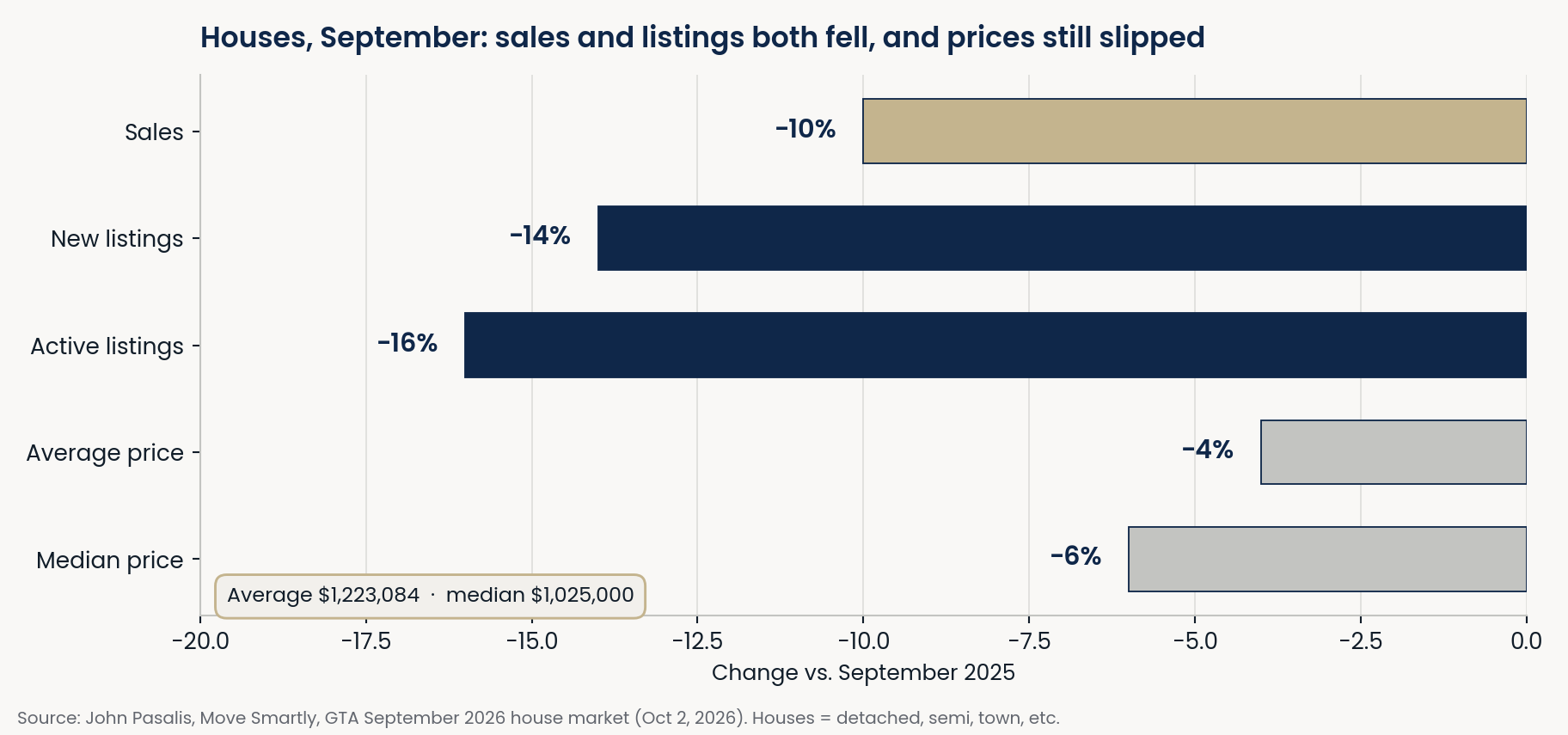
Move Smartly's September report shows GTA house sales down 10% from a year earlier, after giving back 2% in July and 3% in August. That's the third straight month of a widening gap. New house listings fell 14% and active listings fell 16%, so the supply side is pulling back too. The average house price was $1,223,084, down 4%, and the median was $1,025,000, down 6%.
The interesting part is how those numbers fit together. Fewer new listings are coming to market, and the pool of homes for sale is slowly drawing down - months of inventory eased to 4.7 from 5.1 a year ago. Normally, that starts to firm up prices. It hasn't, because demand is pulling back at roughly the same pace. Pasalis puts the blame on two things: higher interest rates, with fixed mortgages now in the mid-4% range and more increases expected, and consumer confidence taking a hit from Canada's collapsed trade talks with the United States. His read for the rest of 2026 is a market that's weakening, not heating up.
I want to be careful with the word "tightening" here, because I've used it in this brief before. There's still a real backlog of homes for sale, and buyers still have genuine choice. What's changing is the flow of fresh listings, which is thinning as sellers who don't have to sell choose to wait. That's an early, in-progress shift, not a shortage - and with demand softening at the same time, it hasn't translated into higher prices yet.
Fewer homes on the market doesn't mean rising prices if fewer buyers are showing up at the same time. |
What does that mean on the ground in York Region? In practice, well-presented, fairly priced detached homes in Stouffville, Markham and Richmond Hill still attract buyers, but there's little reason for anyone to overpay or rush. Sellers who price to the market sell. Sellers who price to last spring's headlines wait. And buyers can ask for inspection and financing conditions again.
2. Condos: Lowest Sales in the Data, Lowest Prices Since 2019
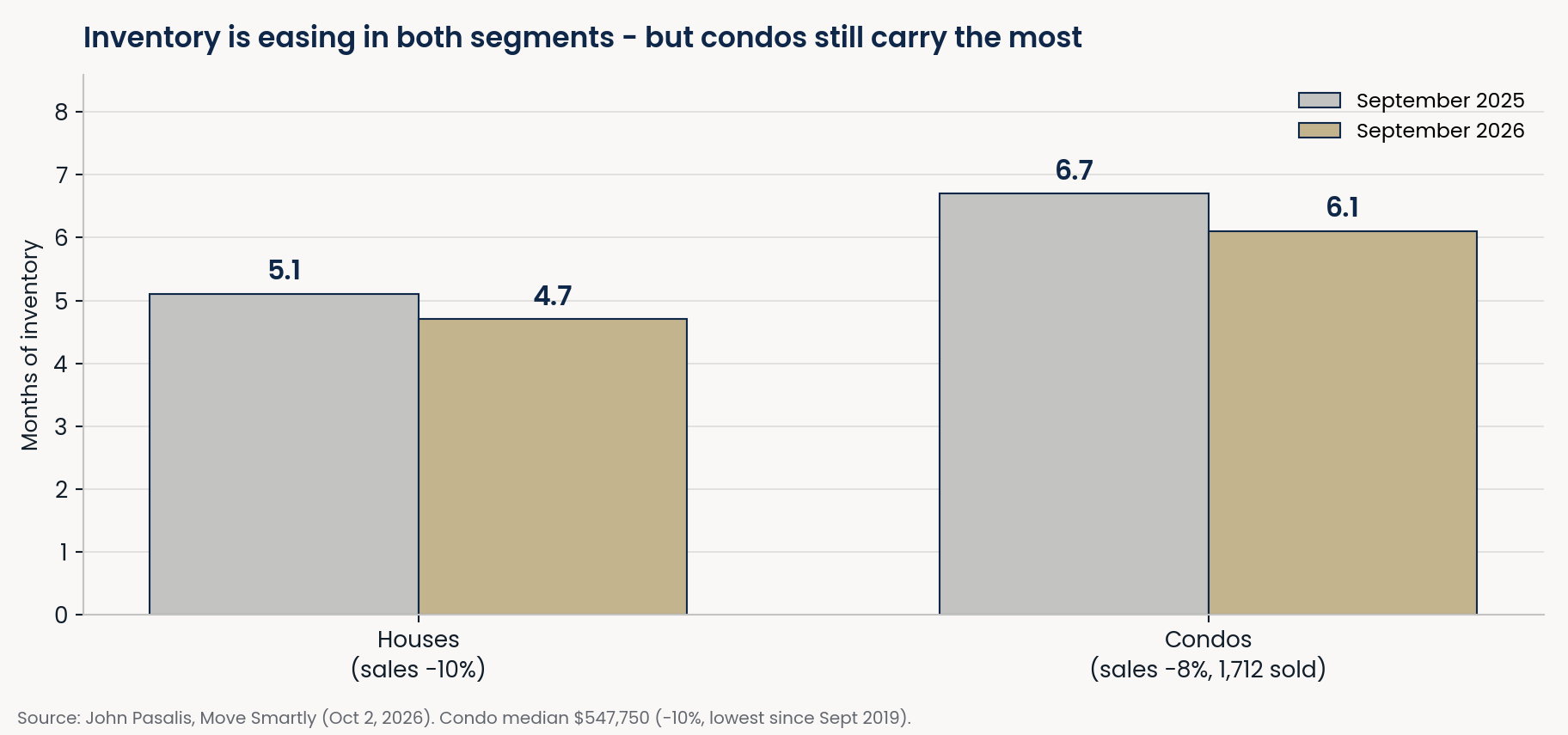
The condo numbers are the weakest in the report. GTA condo sales fell 8% from last year to 1,712 units - the lowest September total in Move Smartly's data, which goes back to 2003. The median condo price was $547,750, down 10% and the lowest since September 2019, with the average at $629,066, down 7%. New listings fell 14% and active listings fell 16%, mirroring the house market.
Condo inventory is still heavier than houses: 6.1 months, compared with 4.7 for houses. That's down from 6.7 a year ago, so the backlog is clearing gradually, but 6 months or more is the zone where buyers hold most of the leverage. That's the case in condo-heavy pockets of Scarborough, North York and downtown, and in newer buildings in Markham and Vaughan.
For buyers, this is a negotiating market and a patient one. For sellers, the message is blunt: you're competing with other resale units and with builders still cutting prices on finished new inventory. For investors, remember that a low entry price only helps if the rent covers the carrying cost - and with mortgage rates going up, not down, that's a harder test than it was a few months ago. There's also a reasonable bottoming argument: sales and prices at multi-year lows, new condo construction almost frozen, and institutional buyers like the Ontario-backed High Art Capital fund bargain hunting. But a bottom is a process, not an event, and we aren't there yet.
3. A Flat July, Oil Above US$100, and a Rate Decision Nobody Can Call
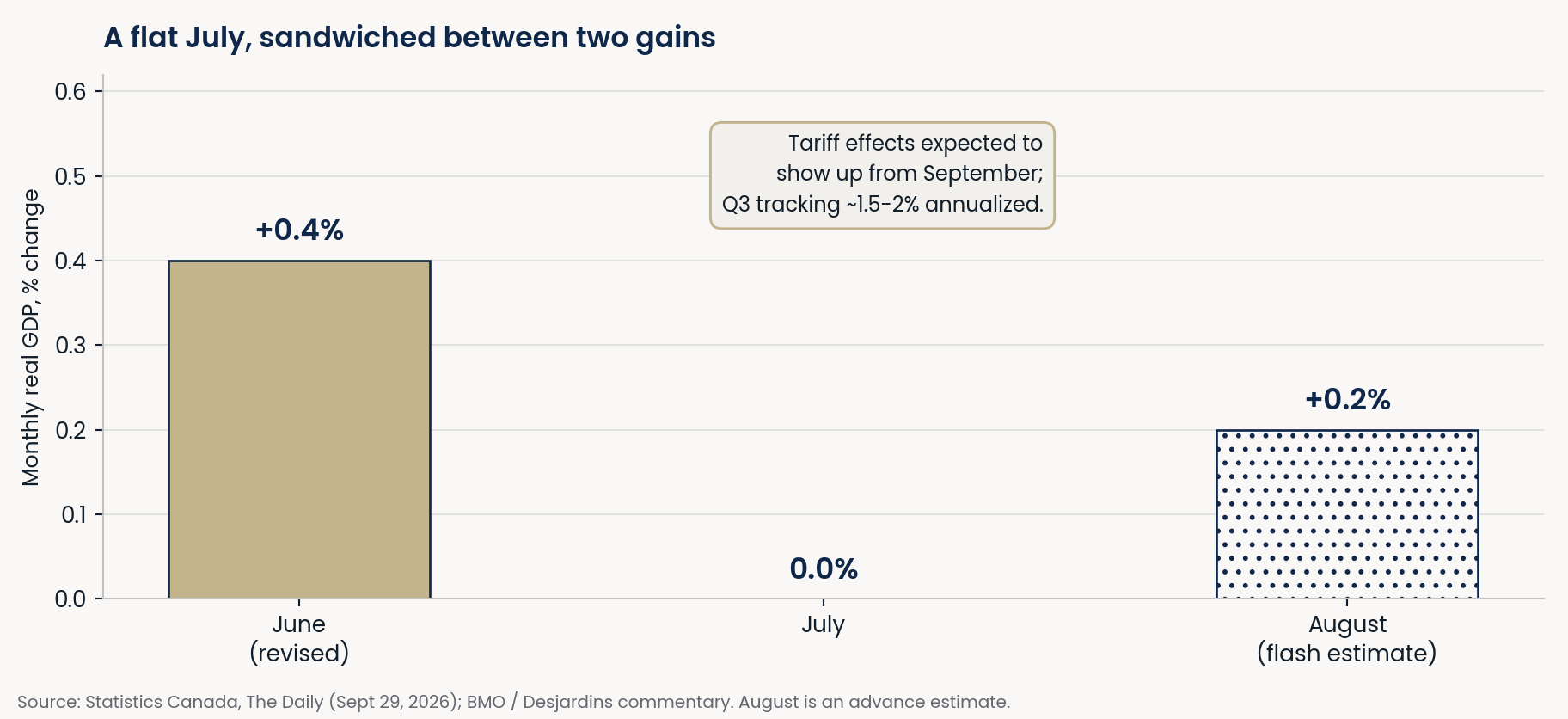
Statistics Canada reported on Tuesday that real GDP was essentially flat in July, right on its earlier flash estimate. June was revised up to +0.4%, and the early read on August is +0.2%. Construction grew for a fourth straight month (+1.3%) and utilities rebounded, but manufacturing fell 0.9% and retail slipped 1%, with the World Cup giving accommodation a lift. TD's Marc Ercolao describes the economy as zigzagging up and down since early 2025. KPMG's Peter Shannon thinks the U.S. tariffs will meaningfully hit in September and show up fully in the fourth quarter. BMO's Benjamin Reitzes has third-quarter growth tracking at 1.5% to 2%, which is roughly in line with the Bank of Canada.
Why this matters for the housing market comes down to the Bank of Canada's October 28 decision, which will include a full new forecast. The Bank has held at 2.25% for seven straight meetings. Markets currently put the odds of a quarter-point hike at roughly 54%, down slightly from about 59% a week ago but still a coin flip. Before the Bank's September 2 hold, markets saw a hold as about 94% likely. The reason for the shift is oil: Brent crude was near US$102 on Friday, down from about US$107 on Monday, but still more than US$25 above the US$70-75 the Bank assumed in its July outlook.
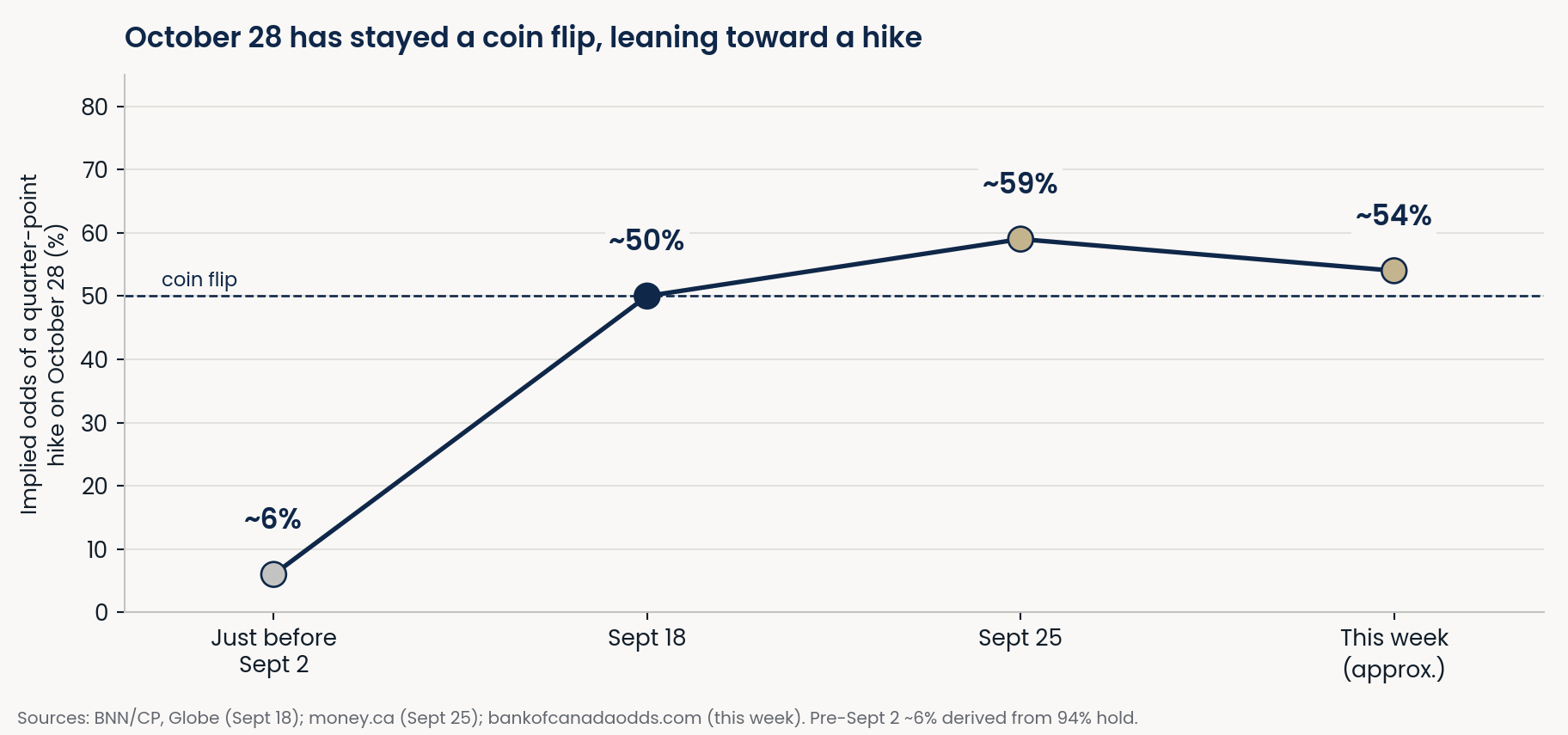
Economists are less convinced than traders. RBC, Desjardins and Capital Economics have all said they expect the Bank to hold in October, with Desjardins and RBC looking to early 2027 for the first move. Desjardins notes that if tariffs push unemployment up, they'd also dampen inflation modestly - but retaliatory tariffs and high oil could push the other way and bring a hike forward. The September jobs report (Friday, October 9) and September CPI (mid-October) are the two data points that will likely tip it. Governor Macklem's September 21 message was that the Bank doesn't want to hike into a slowdown but also doesn't want to be too slow if inflation sticks.
For borrowers, the practical numbers: the best five-year fixed rates are around 4.24% to 4.34% depending on lender and down payment (up from 4.09% at the end of August), the best five-year variable is about 3.40%, and prime remains 4.45%. The five-year Government of Canada bond yield, which drives fixed pricing, was around 3.6%. With roughly 1.15 million mortgages renewing this year, get a written rate hold now - it's free, usually lasts 90 to 120 days, and protects you from a move higher before you close or renew.
4. The Property Tax Question Ontario Homeowners Should Be Watching
One item that didn't get much attention this week but could matter for every homeowner in York Region: the Globe and Mail reported that Ontario's property assessments have been frozen at 2016 values for six years, and the province is consulting on what to do about it. If Premier Doug Ford lifts the freeze, homeowners whose properties have appreciated faster than average would see larger tax increases, while those whose values have fallen may have been overpaying for years.
Why it matters locally: values in Stouffville, Markham and Richmond Hill have moved very differently since 2016 than values in a downtown condo or an older Scarborough bungalow. A reassessment would redistribute the tax burden, and it would show up in carrying costs - which buyers already stretching to afford a 4%-plus mortgage will care about. No decision has been announced, so this is something to watch, not something to price in. But it's a good reason to ask your agent about the current assessment and annual tax on any property you're considering, and to factor in a margin.
Peter's Take
Here's how I'm reading it. September gave us the first real look at what happens when rates drift up, confidence drops and prices are still falling. Buyers slowed down. Sellers who didn't have to sell started waiting. Fewer listings and fewer buyers is a stalemate more than a squeeze. That's a market that rewards people who are prepared and punishes people who are guessing.
If you're buying: get a written rate hold and take the longest one offered. On resale, use the time you have: inspections, financing conditions, and room to negotiate on price, especially in condos, where inventory is highest. Look closely at carrying costs, including property tax.
If you're selling: price to what actually sold nearby in the last 60 days, not what sold in spring. Fewer competing listings is real, but it isn't a guarantee of a premium. Presentation and pricing do the heavy lifting. If you own a resale condo, know that you're competing with builders and with record-low sales.
If you're investing: underwrite at today's rates plus a hike. A condo that only works at a 4.24% mortgage is thinner than it looks, and a median price at a multi-year low isn't automatically a bargain - it's a price discovery process.
What to watch next: TRREB's September Market Watch in the next few days; the September jobs report on Friday, October 9; September CPI in mid-October; whether Brent stays above US$100; and the Bank of Canada's October 28 decision. If you'd like to talk through what this means for your street, price range or renewal date, reach out. That conversation is always more useful than the general one.
Sources
• Move Smartly (John Pasalis) - "GTA Home Sales Slow Again in September," October 2, 2026: insights.movesmartly.com/articles/gta-home-sales-slow-again-in-september
• Statistics Canada - "Gross domestic product by industry, July 2026," The Daily, September 29, 2026: www150.statcan.gc.ca/n1/daily-quotidien/260929/dq260929a-eng.htm
• BNN Bloomberg - "July GDP was flat despite construction, utilities gains: StatCan," September 29, 2026 (TD's Marc Ercolao, KPMG's Peter Shannon, BMO's Benjamin Reitzes): bnnbloomberg.ca/business/economics/2026/09/29/july-gdp-was-flat-despite-construction-utilities-gains-statcan/
• Desjardins Economic Studies - "Canada: Real GDP Took a Summer Break in July," September 29, 2026: desjardins.com/en/savings-investment/economic-studies/canada-real-gdp-29-september-2026.html
• The Globe and Mail - "After a year of rate holds, markets see BoC's next meeting as a coin flip," September 18, 2026 (RBC's Claire Fan, Desjardins' Randall Bartlett, Capital Economics' Stephen Brown)
• BNN Bloomberg / The Canadian Press - "Odds of an interest rate hike from Bank of Canada this year have jumped," September 18, 2026
• money.ca - "Traders now see a Bank of Canada rate hike as a coin flip for Oct. 28," September 25, 2026; Bank of Canada Odds (bankofcanadaodds.com), accessed October 4, 2026 (~54% hike; approximate)
• Trading Economics - Brent crude, October 2, 2026 close (US$102.25): tradingeconomics.com/commodity/brent-crude-oil
• Ratehub.ca / WOWA / nesto.ca - best 5-year fixed and variable mortgage rates, as of October 2, 2026
• The Globe and Mail - "The property tax time-bomb, house-sitters save big and the Home of the Week: Canadian real estate news for the week of Oct. 2," October 2, 2026
• TRREB - Market Watch, August 2026 (released September 3, 2026) - for comparison; September release pending at time of writing
• Bank of Canada - policy rate announcement, September 2, 2026; Governor Macklem speech, September 21, 2026
Peter Kiriazopoulos, Sales Representative · Kompass Realty Group · RE/MAX Ultimate Realty Inc., Brokerage · 1739 Bayview Avenue, Toronto
This brief is provided for general information only and is not intended as financial, mortgage, legal or tax advice. Market data is sourced as cited above and is subject to revision. Not intended to solicit buyers or sellers currently under contract with another brokerage.