

| A landmark week for Canadian housing. TD Bank slashed its 2026 forecast to near-zero growth, the Ontario and federal governments unveiled coordinated HST relief on new builds, CMHC released its Spring Supply Report showing rentals have overtaken condos in Toronto for the first time this century, and Canada’s historic population decline is quietly reshaping demand fundamentals. Here’s what you need to know. |
-1.8% TD 2026 Sales Forecast Revised Mar 26 • Was +9.3% | $117K HST Savings on $900K Home Effective April 1, 2026 | -102K Canada 2025 Population First net decline since WWII | 33-mo Rent Price Low Feb 2026 • 17 straight months falling |
1. TD Bank Slashes Its 2026 Housing Forecast — A Dramatic Mid-Cycle Reversal
The biggest housing story of the week landed on March 26 when TD Economics published a sweeping forecast revision that shocked the market. TD now expects national home sales to fall 1.8% year-over-year in 2026, and national home prices to edge down 0.3% — a complete reversal from its December 2025 forecast of a +9.3% sales jump and +4.1% price gain.
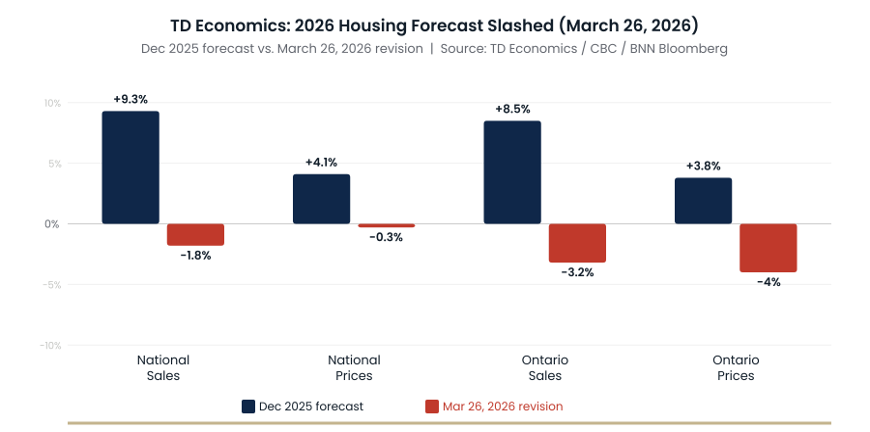
The pain is sharpest in Ontario, where TD now projects a 3.2% sales decline and a 4.0% price drop — down from expectations of +8.5% and +3.8% respectively. TD economist Rishi Sondhi attributed the downgrade to a “subdued economy, heightened uncertainty, and ongoing cost-of-living pressures.” Critically, Sondhi suggested that further price declines may actually be required to draw Ontario buyers back off the sidelines — a notably frank admission from a major bank.
| “Affordability is strained, prices haven’t fallen far enough to pull buyers off the fence, and pent-up demand has yet to re-emerge as quickly as previously expected.” — Rishi Sondhi, Economist, TD Economics — March 26, 2026 |
TD does see a rebound coming — but not until 2027, when it forecasts sales to jump 9.6% and prices to rise 2.7% as economic conditions normalize. The Prairie provinces and Quebec were given more optimistic outlooks, reflecting tighter supply and better relative affordability. TD’s revised numbers place it well to the cautious side of CREA, which still projects a 5.1% rise in 2026 resales.
Sources: CBC News – TD Revises 2026 Forecast · BNN Bloomberg · Canadian Mortgage Professional · CMT News
2. Ontario Budget Week: HST Axed on New Homes, But Housing Starts Revised Down Again
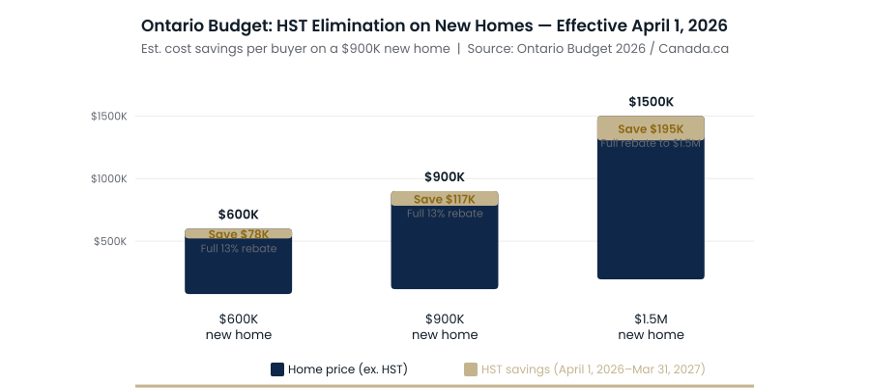
In what was the busiest policy week for housing in years, the Ontario government tabled its 2026 Budget on March 26, led by a headline measure pre-announced the previous day: the full 13% HST will be eliminated on new homes valued up to $1 million, effective April 1, 2026 through March 31, 2027. Enhanced rebates also apply for homes up to $1.5 million. Combined with matching federal legislation covering the 5% federal portion, the joint relief is estimated at $2.2 billion in total tax savings.
The industry welcomed the news. TRREB called the HST elimination “a major step forward,” and BILD praised the coordinated approach as “game-changing” for new construction activity. On March 27, the federal government tabled Bill C-26 (the Improving Housing Supply Act), committing $1.7 billion to provinces to accelerate supply alongside the new Build Canada Homes agency targeting 500,000 completions per year nationally.
But the budget carried a sobering counterweight: Ontario revised its housing start projections down more than 10% — from 315,000 expected starts between 2025–2028 to just 276,900. Finance Minister Peter Bethlenfalvy went further, publicly distancing himself from the province’s own 1.5 million homes target, calling it a “soft target” and saying plainly: “No, no, I’m not focused on the target.”
| “The HST elimination is more a short-term stimulus than a housing affordability policy. Buyers may benefit slightly, but the main goal is to keep shovels in the ground.” — Industry analyst commentary, March 26, 2026 |
Sources: GlobeNewswire – Ontario Budget · CP24 – Ontario Budget Pocketbook · Global News – Starts Revised Down · Canada.ca – Bill C-26 · TRREB – HST Statement
3. Canada’s Historic Population Decline Is Reshaping Housing Demand
A structural demand story that gained significant analyst attention this week: Statistics Canada confirmed Canada’s population declined by approximately 102,000 people in 2025 — the first net annual decline since records began in the 1940s. The driver was a massive departure of non-permanent residents, with approximately 461,000 temporary residents (international students and temporary foreign workers) leaving on a net basis over the year.
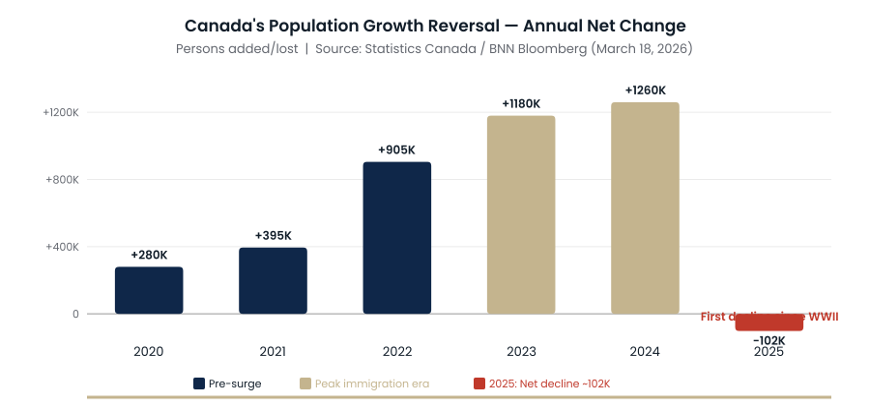
This is an extraordinary reversal. As recently as 2024, Canada was adding 1.26 million people per year — among the fastest population growth rates in the developed world. That surge in demand, colliding with slow housing supply, was a primary driver of the rental inflation and vacancy collapse of 2022–2024. Now the pendulum has swung sharply in the other direction.
Steve Saretsky flagged the implication in his recent Substack newsletter: “Pop growth has gone from 1.2 million per year to -100,000. This is a major swing for the market and for the economy to absorb.” The consequences are already showing up in rental markets: average advertised rents fell to a 33-month low in February 2026, following 17 consecutive months of price declines. BNN Bloomberg reported on March 18 that “housing demand weakens as population growth stalls.”
| “The unwind in Canadian housing is not only due to higher interest rates, but a sharp reversal in immigration. Population growth has gone from 1.2 million per year to -100,000. That’s a major swing for the market and for the economy to absorb.” — Steve Saretsky, The Saretsky Report Substack, March 2026 |
Ben Rabidoux of Edge Realty Analytics noted the secondary effect: Canada is quietly building nearly 180,000 purpose-built rental units nationally — precisely at the moment when rental demand is falling. Vacancy rates, currently at 2.3%, could rise toward levels last seen in the early 1990s and potentially approach 5% nationally. For investors in purpose-built rental projects, the timing is uncomfortable.
Sources: BNN Bloomberg – Population & Demand · CMP – Population Decline · Steve Saretsky – The Saretsky Report · Over Here Toronto
4. CMHC Spring Supply Report: Rentals Overtake Condos, But Toronto Still Dead Last
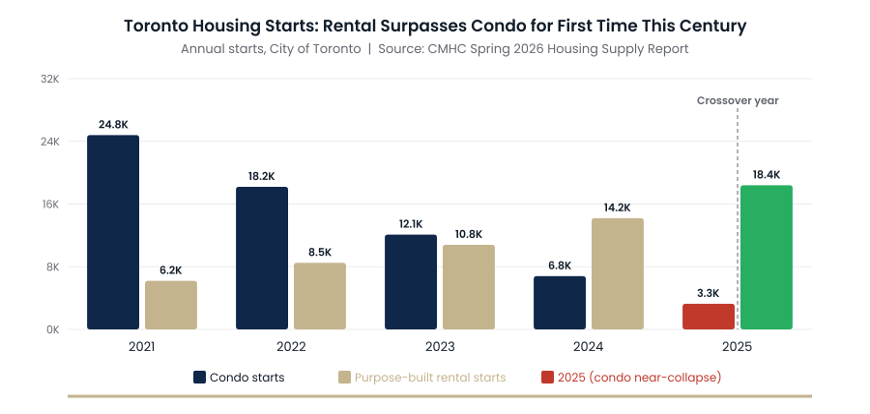
The CMHC released its Spring 2026 Housing Supply Report this week, and it contained a landmark data point: for the first time this century, rental starts exceeded condo starts in the City of Toronto. In a city built on high-rise condo towers, this represents a genuine structural shift in how new housing is being produced.
Total missing middle starts — multiplexes, low-rise apartments, row homes, stacked townhouses — rose roughly 10% nationally in 2025. Nationally, this is a positive sign. In Toronto specifically, multiplex permit applications tripled between 2023 and 2024 following the city’s 2023 as-of-right rezoning for up to four units per property. Daniel Foch described the emerging multiplex trend as a “pretty solid wealth creation tool” for small investors, “democratizing the ability to create housing.”
However, CMHC’s report also delivered a damning headline: Toronto ranked last among all major Canadian cities in housing construction per capita in 2025 — building at its lowest rate in over 15 years. Calgary and Edmonton, by contrast, had roughly 60% of all new starts in the missing middle category. The condo construction collapse (down 88% over three years to 3,272 units in 2025) continues to more than offset gains in other categories. CMHC says Canada needs to build 430,000–480,000 new units per year to restore 2019-era affordability by 2035 — a target that looks increasingly out of reach.
Sources: CMHC – Spring 2026 Housing Supply Report · CMT – Multiplexes as Next Supply Engine · CMHC – Toronto Ranked Last · BILD – Improving Housing Supply Act
5. The Correction Gets Personal: Homes Selling at $500K–$600K Losses vs. 2022
This week, blogTO documented the now-recurring phenomenon of Ontario homeowners crystallizing massive losses compared to peak-2022 purchase prices. A Newmarket home that sold for $1.608 million in March 2022 just closed at $1.051 million in February 2026 — a loss of $557,000 in four years after multiple failed re-listing attempts. A separate Caledon property sold at nearly $600,000 below its 2022 price. A downtown Toronto home with eight listing attempts finally sold at a $1.35 million loss.
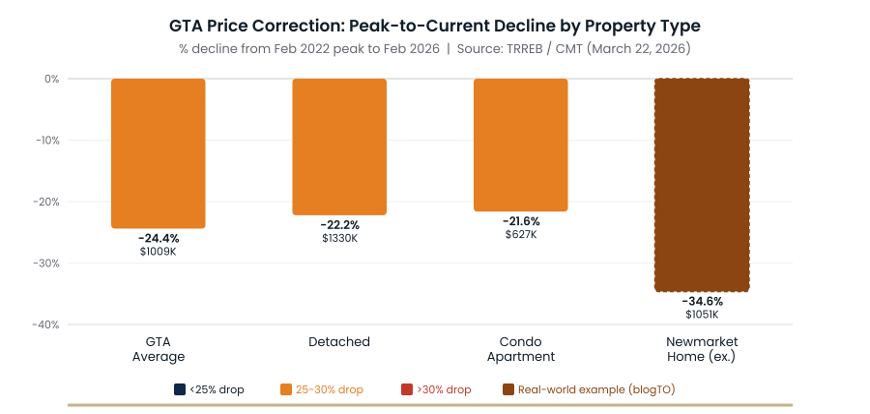
These aren’t cherry-picked outliers. TRREB data show the GTA average price is down 24.4% from February 2022’s $1,334,544 to this February’s $1,008,968. Condo prices have fallen from ~$800,000 to ~$625,000 over the same period — a nearly 22% decline. Canadian Mortgage Trends published analysis this week drawing parallels to the 1989–1995 correction, when prices didn’t bottom until falling 28.5% — and didn’t recover in real terms until 2011.
Both the Move Smartly / John Pasalis March roundtable and Daniel Foch’s recent commentary note “a prolonged wait-and-see phase” among buyers. Foch: “The assumption heading into 2026 was that the market had already reached its bottom in 2025. But February’s numbers suggest that assumption may have been premature.” He expects prices to stop declining in 2027 and then plateau for an extended period — echoing the 1990s playbook.
| “The assumption heading into 2026 was that the market had already reached its bottom in 2025. But February’s numbers suggest that assumption may have been premature — 2026 has officially broken the floor established last year.” — Daniel Foch, Real Estate Magazine, March 2026 |
Sources: blogTO – $557K Loss (Newmarket) · blogTO – $600K Loss (Ontario) · blogTO – $500K Loss (Toronto) · CMT – Toronto Prices Down 24% · Daniel Foch – REM · Move Smartly / Pasalis Roundtable
6. The $1.3B Condo Buyout: Government Bails Out Developers or Solves a Real Problem?
In a move that drew equal parts praise and eye-rolls from the industry, investment firm High Art Capital announced on March 10 the launch of a $1.3 billion fund to buy blocks of newly completed, unsold GTA condos and convert them into long-term rentals. The anchor investor: the province’s own Building Ontario Fund (BOF), a Crown agency, committing up to $300 million in mezzanine debt. The rest — roughly $733 million — will be raised from private investors.
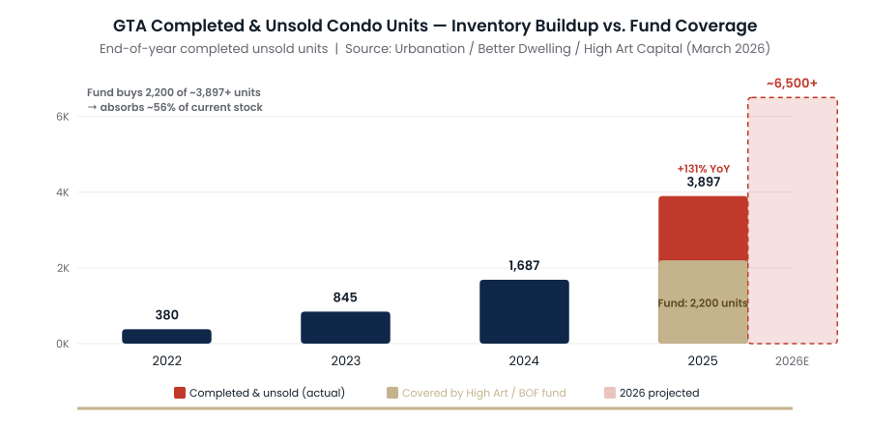
The target is 2,200 units across Toronto, Durham, Halton, Peel, and York Region, with approximately 550 units designated affordable — set at the lower of 25% below market rent or 30% of median household income, protected in perpetuity through title registrations. Property management will be handled by Del Condominium Rentals (Tridel’s arm) and Menkes Condominium Rentals. To be eligible, developers must submit blocks of at least 10 vacant units in buildings completed on or after January 1, 2023.
The market context makes the rationale clear: Urbanation counted 3,897 completed and unsold condo units across the GTA at the end of 2025 — a 131% year-over-year increase and five times the level seen in 2023. Newly delivered buildings in 2026 are running roughly 20% unsold, up from 5% in 2025. With sales at near-historic lows, developers are carrying completed inventory they can’t sell and can’t afford to hold indefinitely.
| “Cue the bailouts… The new condo market is effectively dormant, with just 262 sales in Q4 against more than 20,000 unsold units — almost 20 years of unsold inventory at the current sales pace.” — Robert Kavcic, Senior Economist, BMO Capital Markets — March 2026 |
The criticism from BMO and Better Dwelling is pointed: at 2,200 units, the fund absorbs roughly 56% of today’s completed unsold stock — but Urbanation estimates close to 15,000 units of unsold inventory are heading to market in the coming years. The fund is, in effect, a liquidity lifeline for developers who are over-leveraged on projects that can’t clear at current prices. Better Dwelling called it a bailout that “confirms a market so inefficient it requires state-backed intervention” and warned it risks “extending market inefficiencies” rather than resolving them.
The more charitable read: converting stranded supply into affordable rental housing at zero direct government subsidy (BOF uses debt, not grants) is genuinely creative policy. The 550 affordable units, protected permanently on title, are a real outcome. The question is whether it creates the right incentives for developers going forward — or simply signals that Ontario will backstop bad bets.
Sources: Storeys.com – $1.3B Fund Launch · Urban Toronto – 2,200 Units to Rental · Toronto Life · Better Dwelling – Bailout Analysis · Globe and Mail · Deeded – Developer Guide
Key Takeaways This Week
- TD’s forecast reversal is the most credible signal yet that 2026 will not be a recovery year for Ontario real estate. When a major bank flips from +9.3% to -1.8% sales in a single quarter, that’s a fundamental reassessment, not a minor tweak.
- The HST elimination (April 1–March 31, 2027) is real money — $78K–$195K in savings on new builds. If you’ve been sitting on a new-construction purchase, this window is worth acting on. But check developer financial health before signing.
- Canada’s population decline is a slow-moving structural story that will keep rental demand subdued for the next 12–24 months. If you’re an investor holding income property in Toronto, the rental tailwind that justified buying at 2022–2023 prices is gone.
- The price correction isn’t over. The 1990s parallel is uncomfortable: a bottom in 2027, followed by years of flat prices, is the base case among the most credible voices in this market (Foch, Saretsky, TD Economics). Buying time matters more than ever.
- Multiplexes are emerging as the next real estate investment opportunity in Toronto. As-of-right six-unit permissions, HST relief, and the collapse of the condo development model are all pointing toward small-scale gentle density as the next supply engine.
- The $1.3B BOF buyout is creative policy — but it’s a drop in a very large bucket. It converts 2,200 units and adds 550 affordable rentals, which is real. But with 15,000+ unsold units heading to market, developers sitting on stalled projects need more than one creative fund. If you’re a developer with eligible completed inventory, submit now — blocks of 10+ units, completed post-January 2023.
This roundup was compiled from publicly available sources published March 22–29, 2026. All citations and links are included above.