


Weekly GTA Housing Market Brief
The Fed Hiked, the Bank of Canada Warned It Could Be Next,
and Ontario Just Bought 43 Toronto Condos at a Discount.
Monday, September 28, 2026 · Peter Kiriazopoulos, Kompass Realty Group
~59% market odds of a Bank of Canada hike on Oct 28 | 4.24% best 5-yr fixed, up from 4.09% in late August | $518K average per unit Ontario's fund paid for 43 condos | US$107 Brent crude Monday, after Hormuz deal rejected |
Welcome back - and my apologies for the quiet stretch. It's been four weeks since the last brief, so this edition leads with the past seven days and folds in the September numbers you'd have seen along the way.
Here's the frame I'd use heading into this week. The cost of borrowing is moving up, not down. The U.S. Federal Reserve raised rates for the first time in three years. The Bank of Canada's governor told a Halifax audience he doesn't want to be too slow if inflation starts to stick. Markets now see an October 28 hike as roughly a coin flip, and the cheapest five-year fixed mortgage has climbed back to around 4.24%. Most private buyers are responding the way you'd expect: carefully.
So the more interesting question this week is who is still buying. Two answers stood out. Families buying new low-rise homes are, helped by the HST rebate. And the Province of Ontario is: its new investment fund bought 43 unsold condos in midtown Toronto for about $518,000 each. Both stories say a lot about where the opportunities are for buyers and sellers in Markham, Stouffville, Richmond Hill, Vaughan, Newmarket, Scarborough and Toronto right now. Let's go through it.
This Week at a Glance
Indicator | Latest | Prior | Read |
Odds of BoC hike, Oct 28 | ~59% (Sept 25) | ~6% (pre-Sept 2) | Now a coin flip |
U.S. Fed funds rate (Sept 16) | 3.75-4.00% | 3.50-3.75% | First hike since 2023 |
BoC policy rate / prime | 2.25% / 4.45% | unchanged | Held Sept 2 |
Best 5-yr fixed / variable | 4.24% / 3.40% | 4.09% (Aug 30) | Gap widened to 84 bps |
5-yr Government of Canada yield | ~3.60% | 3.72% (Sept 24 high) | Fixed rates follow this |
Brent crude (Mon Sept 28) | US$107 | US$104 (Fri) | Hormuz offer rejected |
CPI, August / core trim-median | 3.0% / 1.9-2.0% | 3.0% (July) | Gasoline-driven |
GTA new home sales, August | 907 | 37% below 10-yr avg | Low-rise strong, condo weak |
GTA resale, August (TRREB) | 5,057 sales / $993,410 | -2.1% / -2.7% YoY | New listings -14.1% |
1. The Fed Hiked, Macklem Changed His Tone, and October Became a Coin Flip
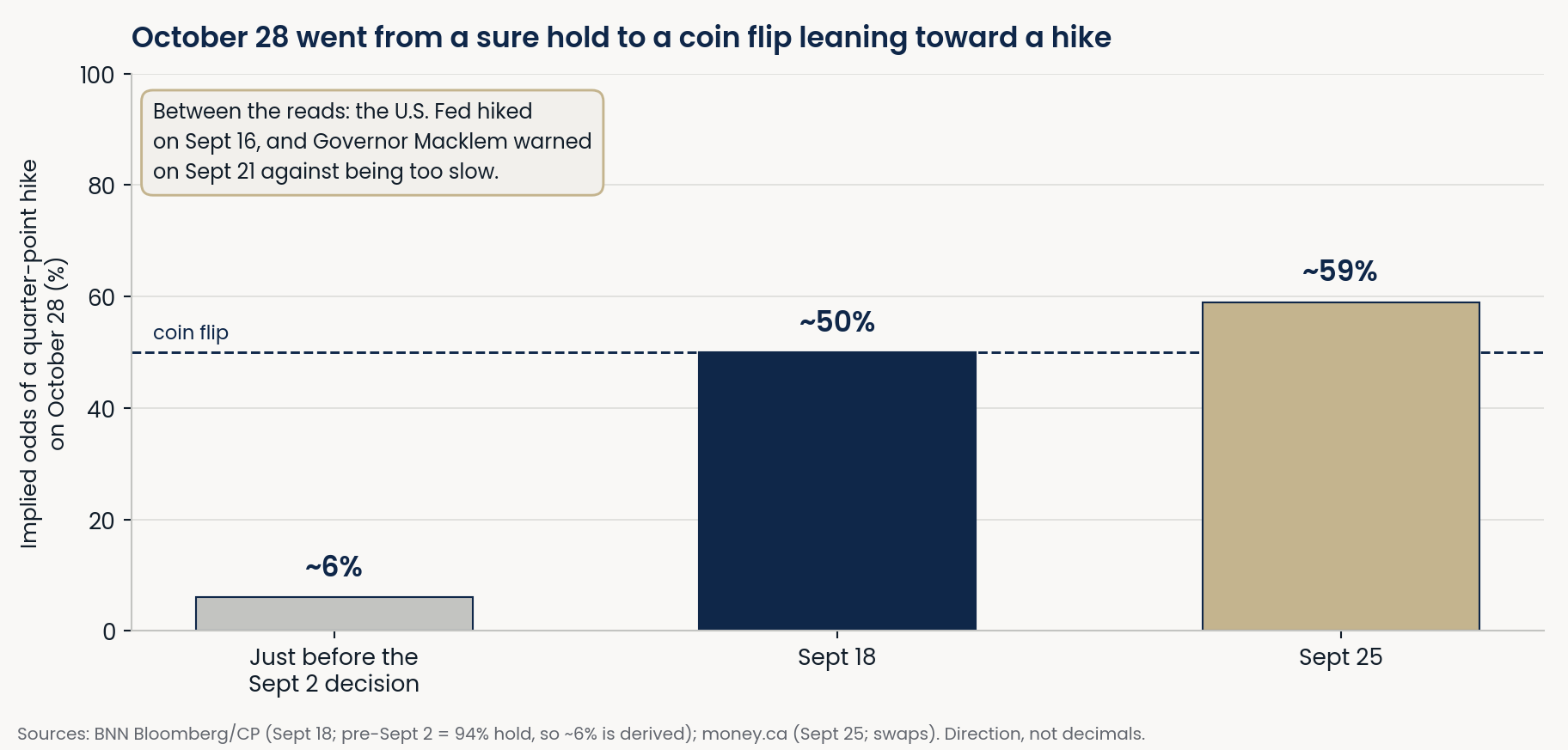
On September 16, the U.S. Federal Reserve voted unanimously to raise its policy rate by a quarter point, to 3.75%-4.00% - its first increase since July 2023. The Fed said inflation remains elevated while spending and hiring have held up, and its officials pencilled in one more hike before year-end. That matters here because Canadian bond yields tend to move with American ones, and our fixed mortgage rates follow our bond yields.
Five days later, on September 21, Bank of Canada Governor Tiff Macklem gave a speech in Halifax that markets read as a shift in tone. His message, in plain terms: the Bank doesn't want to raise rates and slow the economy if inflation stays contained, but it also doesn't want to wait too long if price pressures start to stick. He said that if oil stays near US$100, he expects inflation to edge higher in the months ahead - the Middle East disruptions were supposed to ease by July, and they haven't. He also flagged the other side: if the new U.S. tariffs stay in place, fourth-quarter growth could be roughly cut in half, to below 1%. Two forces, pulling in opposite directions.
Markets heard the first half louder. Just before the Bank's September 2 hold, traders put the odds of a hold at October 28 at about 94%. By September 18 the meeting was a coin flip, and as of September 25, swaps implied about a 59% chance of a hike. Economists are more divided than the market. RBC's Claire Fan points to oil as the single biggest thing driving the pricing. Desjardins' Randall Bartlett expects the Bank to stay put through year-end and move in early 2027, noting that higher bond yields are already doing some of the tightening. Capital Economics' Stephen Brown says his base case is no hike in October, but calls it a close call.
I owe you a straight correction here. In the August 30 brief, I pointed to falling bond yields and said sub-4% fixed mortgages could come back if that trend continued, and that some economists thought the Bank's next move might even be a cut. The opposite happened. Yields turned higher, the cut talk disappeared, and the conversation is now about whether the first hike comes in October or December. I'd rather show you the miss than quietly move on from it.
Nobody credible is talking about rate cuts anymore. The debate is about timing: October, December, or early next year. |
2. Fixed Rates Are Climbing, and Oil Is the Reason
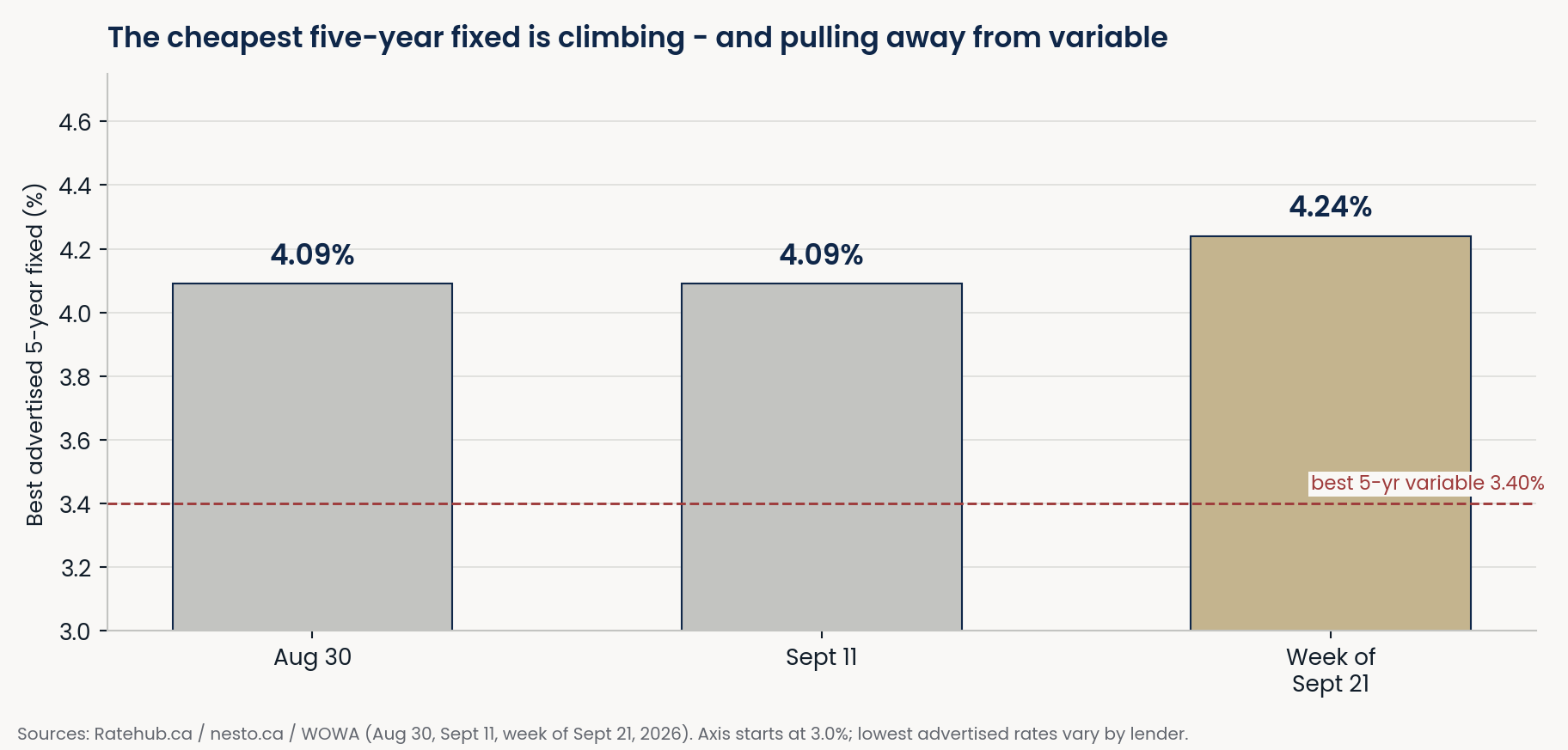
You can already see all of this in lender pricing. The best five-year fixed rate rose to about 4.24% last week, up from 4.09% at the end of August, and some lenders are posting higher still. The best five-year variable is around 3.40%, with prime unchanged at 4.45%. That puts the gap between fixed and variable at about 84 basis points, the widest it's been in months. The five-year Government of Canada bond yield, which drives fixed pricing, touched 3.72% on September 24 before easing to about 3.60% by Friday.
Oil is doing most of the pushing. Brent crude has spent most of September above US$100. It dipped to about US$104 on Fridayafter Iran's foreign minister offered to reopen the Strait of Hormuz and restart nuclear talks within a week, on Tehran's conditions. Over the weekend, President Trump rejected that proposal, and on Monday morning Brent jumped almost 3% to about US$107. The Bank of Canada's July outlook, the one that brought inflation back to 2% by early next year, assumed oil at US$70-75. We're a long way from there.
The good news is that inflation hasn't spread yet. August CPI held at 3.0%, with gasoline doing most of the work, and the Bank's preferred core measures stayed right around 2% (CPI-trim 1.9%, CPI-median 2.0%). That's exactly why Macklem framed it the way he did. As long as the core stays near target, the Bank can look through expensive gas. The September CPI, due in mid-October just before the rate decision, will be the first reading taken with oil above US$100 for a full month, and it will probably decide October.
If you're buying or renewing in the next four months, get a rate hold in writing now. It costs nothing and protects you from exactly the move we just watched. |
With roughly 1.15 million Canadian mortgages renewing this year, the practical advice hasn't changed, it has just gotten more urgent. Holds typically last 90 to 120 days. And the old logic of choosing variable and waiting for cuts doesn't have a cut at the end of it right now - so choose your term based on how much payment risk you can comfortably carry, not on a forecast.
3. Ontario Became Toronto's Newest Condo Buyer - at About Half the New-Build Price
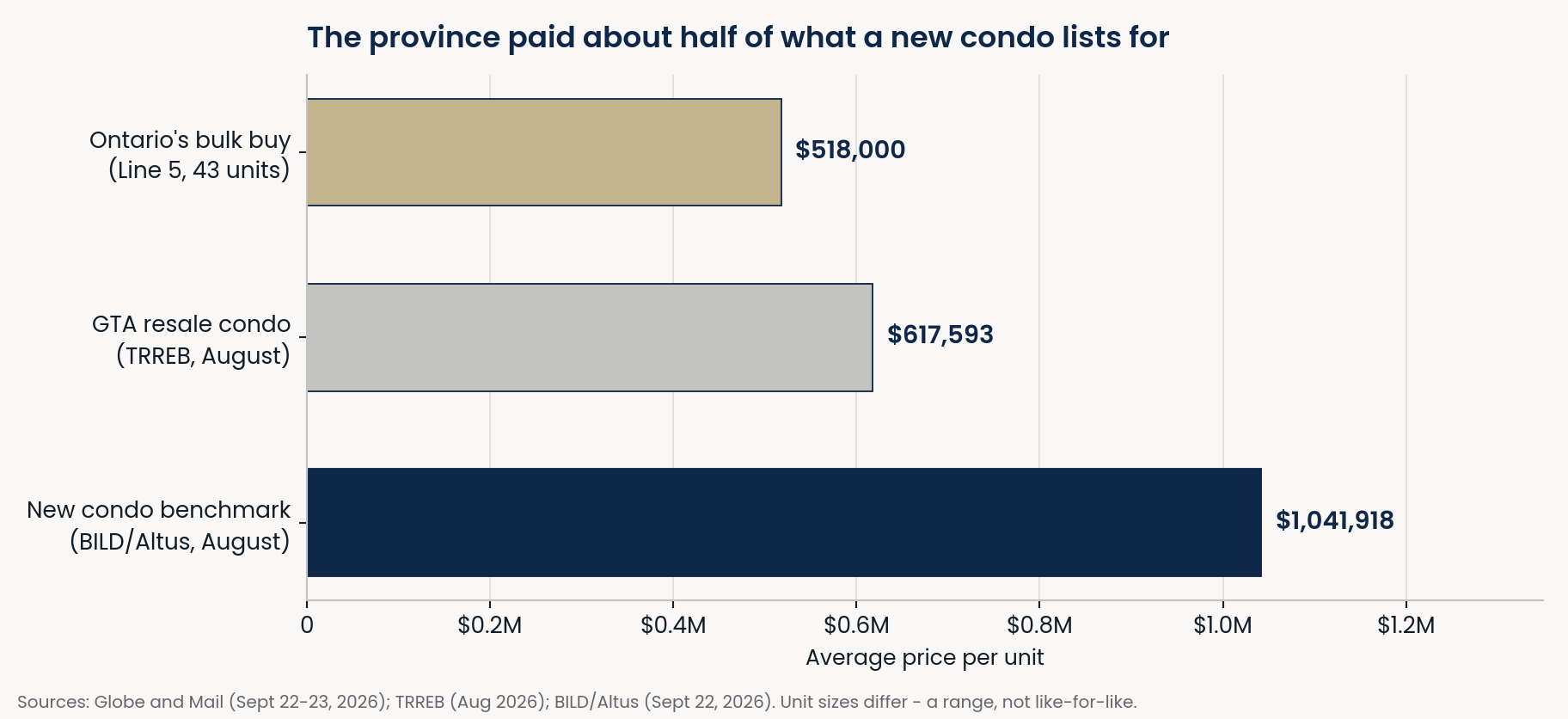
This was the most revealing housing story of the week. The Globe and Mail reported that High Art Capital - a new $1.3-billion investment fund backed by $300 million from the provincial Building Ontario Fund - made its first purchase: 43 unsold units at the Line 5 condos near Yonge and Eglinton for $22.3 million, or about $518,000 per unit. The developers, Westdale Properties and Reserve Properties, sold at a price well below what individual buyers had been paying, and described it as a good chance to move inventory in a slow market.
The plan is bigger than one building. The fund aims to buy about 2,200 unsold condos across Toronto, hold them for at least five years, and then sell most of them. About 550 will be kept permanently as below-market rentals. The first batch includes units set aside for unionized health-care workers at 25% below market rent - roughly $1,800 a month for a one-bedroom instead of $2,400.
Why does this matter if you're not buying in midtown? Three reasons. First, it puts a real, recent price on unsold new inventory: about $518,000, compared with an average GTA resale condo apartment at $617,593 in August and a new-condo benchmark above $1 million. Unit sizes differ, so this isn't a perfect comparison, but the direction is clear. Second, it's a sign the province sees value at these prices - it is buying at a discount with a five-year view, which is the same logic a patient private buyer might use. Third, it takes some of the overhang off the market, which helps condo owners across Scarborough, North York and downtown who've been competing with builders discounting brand-new units.
There's another way to read it, and I think it's fair to say it out loud: when a provincial fund becomes a buyer of last resort for unsold condos, that tells you how weak private demand for that product still is. Toronto started just 1,192 homes of all types in August, down 45% from a year earlier, according to CMHC, and CMHC's fall supply report found only 156 condo units started downtown in the first half of this year. The condo pipeline isn't just slow. For now, it's barely moving.
4. Two Markets: Low-Rise Is Selling, Condos Are Waiting
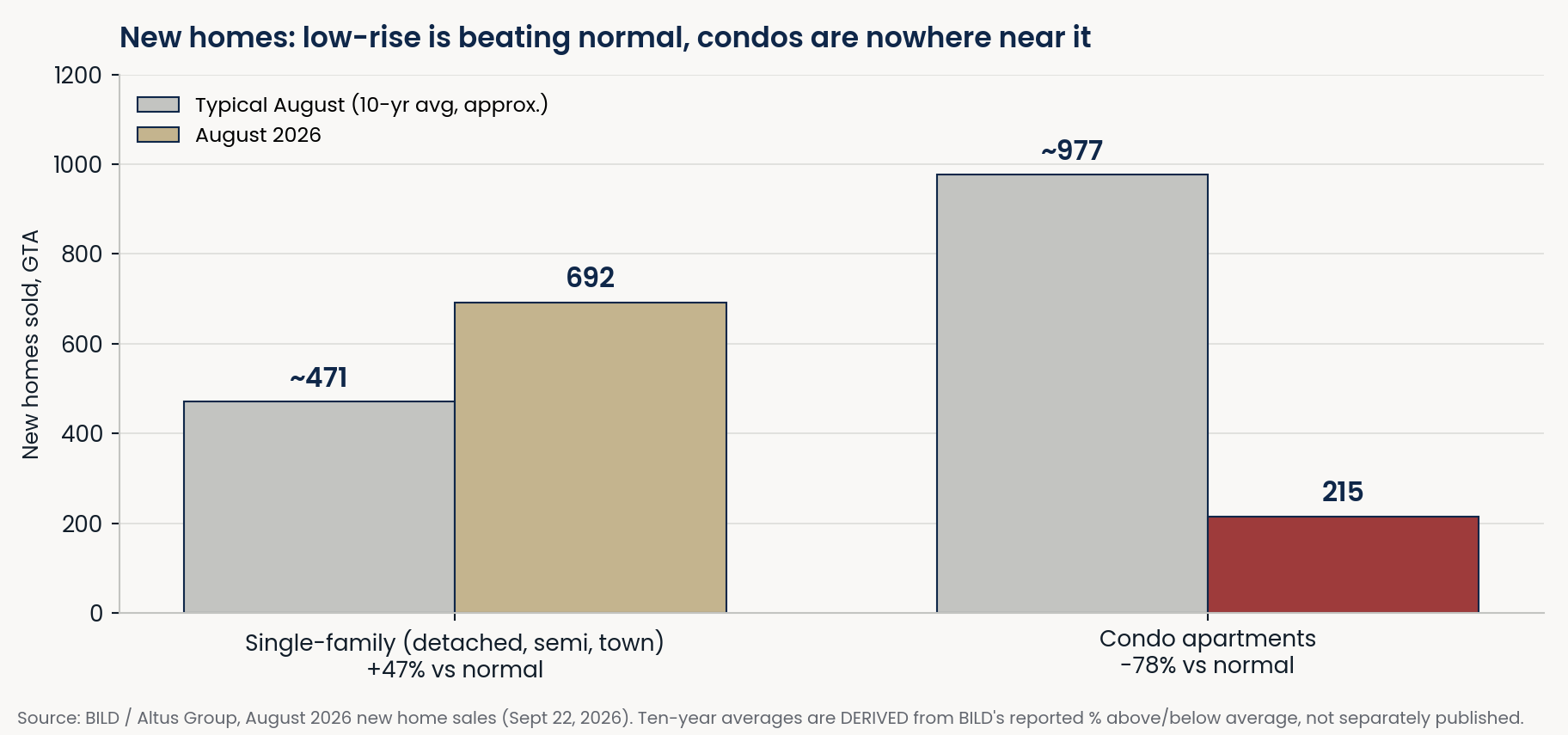
The BILD/Altus new-home numbers for August, released September 22, show just how split this market is. Total new home sales were 907, still 37% below the ten-year August average. But underneath that, single-family sales hit 692 - about 47% above normal - the fifth straight month above the ten-year average. Condo apartments sold just 215 units, 78% below normal. BILD credits the HST rebate on new homes for getting low-rise buyers off the sidelines, and prices help too: the new single-family benchmark was $1,248,866, down 14.6% from a year ago. The new-condo benchmark, at $1,041,918, was actually up 1.3%. There are 19,030 new homes sitting in inventory across the GTA, 12,734 of them condos.
If you're shopping for a new detached or townhome in Stouffville, Markham, Vaughan, Richmond Hill, Newmarket or further north into Simcoe County, that's the most important line in this brief: new low-rise is priced meaningfully lower than a year ago, and the rebate is still there. Ask about it. If you're weighing new versus resale, compare the after-rebate price, not the sticker.
The resale side is steadier than exciting. TRREB's August report showed 5,057 sales, down 2.1% from last year, with new listings down 14.1% and the average price at $993,410, down 2.7%. Active listings were about 24,500, down roughly 11% from a year ago. Nationally, CREA's August numbers (released September 15) showed sales essentially flat for a fourth straight month, a sales-to-new-listings ratio of 49.1% and 4.8 months of inventory - a balanced market by any definition. Fresh listings are pulling back, and the pool of homes for sale is slowly drawing down, but there's still a real backlog to work through, and buyers still have genuine choice.
One thing to keep in mind as September's numbers arrive in early October: they'll be the first to show how buyers reacted to rising fixed rates. Don't be surprised if the fall market starts slowly. That's not a collapse, it's people waiting to see what October 28 brings.
Peter's Take
Here's how I'm reading it. Rates are more likely to go up than down from here, and prices are still below last year. That combination doesn't come around often, and it rewards people who move on their own timeline over people waiting for a perfect moment. It's also worth noticing who is acting decisively right now: new-home buyers using the rebate, and a provincial fund buying condos at a discount with a five-year view. Both are betting on value today, not on rate cuts tomorrow.
If you're buying: get a written rate hold now and take the longest one offered. If you're open to new construction, the low-rise numbers are the best they've been in a while - especially across York Region. On resale, use the balanced conditions: time for inspections, room to negotiate, and no need to waive conditions.
If you're selling: price to what sold nearby in the last 60 days. If you own a resale condo, know what you're competing with - builders and now a provincial fund are setting reference points well below 2022 levels. If you own a detached home in Markham, Stouffville or Richmond Hill, remember that new low-rise down the road may be offering a rebate you can't; presentation and pricing matter more than ever.
If you're investing: underwrite at today's rates plus a hike. A deal that only works at 4.24% fixed is thinner than it looks. The province's move tells you where sophisticated money sees condo value - roughly the low-$500,000s for new midtown units - and it's buying with a long hold. If you can't hold that long, be careful.
What to watch next: TRREB's September numbers in the first week of October; whether Brent stays above US$100 after the rejected Hormuz proposal; September CPI in mid-October; and the Bank of Canada's October 28 decision, which comes with a full new forecast. That's where we'll find out if the market's coin flip lands on a hike.
As always, if you want to talk through what this means for your street, your price range or your renewal date, reach out. That conversation is always more useful than the general one.
Sources
• Federal Reserve - FOMC statement, September 16, 2026: federalreserve.gov/newsevents/pressreleases/monetary20260916a.htm
• CNBC - "Fed rate decision September 2026: Rates rise to 3.75%-4%," September 16, 2026: cnbc.com/2026/09/16/fed-rate-decision-september-2026.html
• Canadian Mortgage Trends - "Bank of Canada's Macklem flags risk of delaying rate hike too long," September 21, 2026: canadianmortgagetrends.com/2026/09/bank-of-canadas-macklem-flags-risk-of-delaying-rate-hike-too-long/
• CP24 / The Canadian Press - "Macklem says U.S. trade unpredictability could set back recent economic progress," September 21, 2026: cp24.com/news/money/2026/09/21/
• BNN Bloomberg / The Canadian Press - "Odds of an interest rate hike from Bank of Canada this year have jumped," September 18, 2026 (Claire Fan, RBC; Randall Bartlett, Desjardins; Stephen Brown, Capital Economics): bnnbloomberg.ca/business/economics/2026/09/18/
• money.ca - "Traders now see a Bank of Canada rate hike as a coin flip for Oct. 28," September 25, 2026: money.ca/mortgages/mortgage-rates/bank-of-canada-rate-hike-odds-october-2026
• Ratehub.ca - Best 5-year fixed mortgage rates, updated September 26, 2026: ratehub.ca/best-mortgage-rates/5-year/fixed
• Trading Economics - Canada 5-year bond yield and Brent crude, September 24-28, 2026: tradingeconomics.com
• NPR - "Trump rejects plan to reopen Strait of Hormuz," September 26, 2026: npr.org/2026/09/26/
• CNBC - "Oil prices jump as Trump rejects Iranian proposal to reopen Strait of Hormuz," September 28, 2026: cnbc.com/2026/09/28/oil-price-today-wti-brent-trump-iran.html
• Statistics Canada - "Consumer Price Index, August 2026," The Daily, September 2026
• Bank of Canada - "Bank of Canada maintains the policy rate at 2¼%," September 2, 2026
• The Globe and Mail - "Ontario-backed High Art Capital pays $22.3-million for 43 unsold Toronto condo units," September 22-23, 2026: theglobeandmail.com/business/article-high-art-capital-unsold-toronto-condo-units/
• BILD / Altus Group - "New home sales in the GTA continue their positive momentum throughout August," September 22, 2026 (GlobeNewswire)
• CMHC - "Housing starts and construction data for August 2026," September 2026: cmhc-schl.gc.ca/media-newsroom/news-releases/2026/
• CMHC - "Fall 2026 Housing Supply Report," September 10, 2026 (via STOREYS)
• TRREB - Market Watch, August 2026, released September 3, 2026
• CREA - National statistics, August 2026, released September 15, 2026: stats.crea.ca
Peter Kiriazopoulos, Sales Representative · Kompass Realty Group · RE/MAX Ultimate Realty Inc., Brokerage · 1739 Bayview Avenue, Toronto
This brief is provided for general information only and is not intended as financial, mortgage, legal or tax advice. Market data is sourced as cited above and is subject to revision. Not intended to solicit buyers or sellers currently under contract with another brokerage.