


Weekly GTA Housing Market Brief
The Hold That Hinged on Oil — Then Oil Blinked,
and the Cut Path Reopened.
Sunday, June 14, 2026 · Peter Kiriazopoulos, Kompass Realty Group
2.25% BoC policy rate — 5th straight hold (June 10) | US$86 Brent crude — lowest since early March | 2.8% April CPI inflation the Bank is watching | ~4.3% best 5-yr fixed — stuck near 4% on bond yields |
Welcome back. The headline event of the week was Wednesday's Bank of Canada decision — and on the surface it was the least surprising story of the year. The Bank held its policy rate at 2.25% for a fifth straight time, exactly as every economist expected. But the reason it gave, and what happened in the days right after, is where the actual news lives.
Here's the frame I'd use. The Bank leaned on one big excuse to stay on the sidelines — oil prices that had spiked on the Middle East conflict. Then, within 48 hours of the decision, oil started falling hard — and by this weekend a U.S.–Iran deal was reportedly taking shape. If that holds, the single loudest argument against rate cuts is quietly losing its voice. Underneath the rate drama, the GTA itself is still running at two speeds: freehold prices in Markham, Richmond Hill, Stouffville and Newmarket are firming month-to-month, while the downtown Toronto and Scarborough condo market is still stuck. Let's get into it.
1. A Fifth Straight Hold — and Why It Was Really About Oil
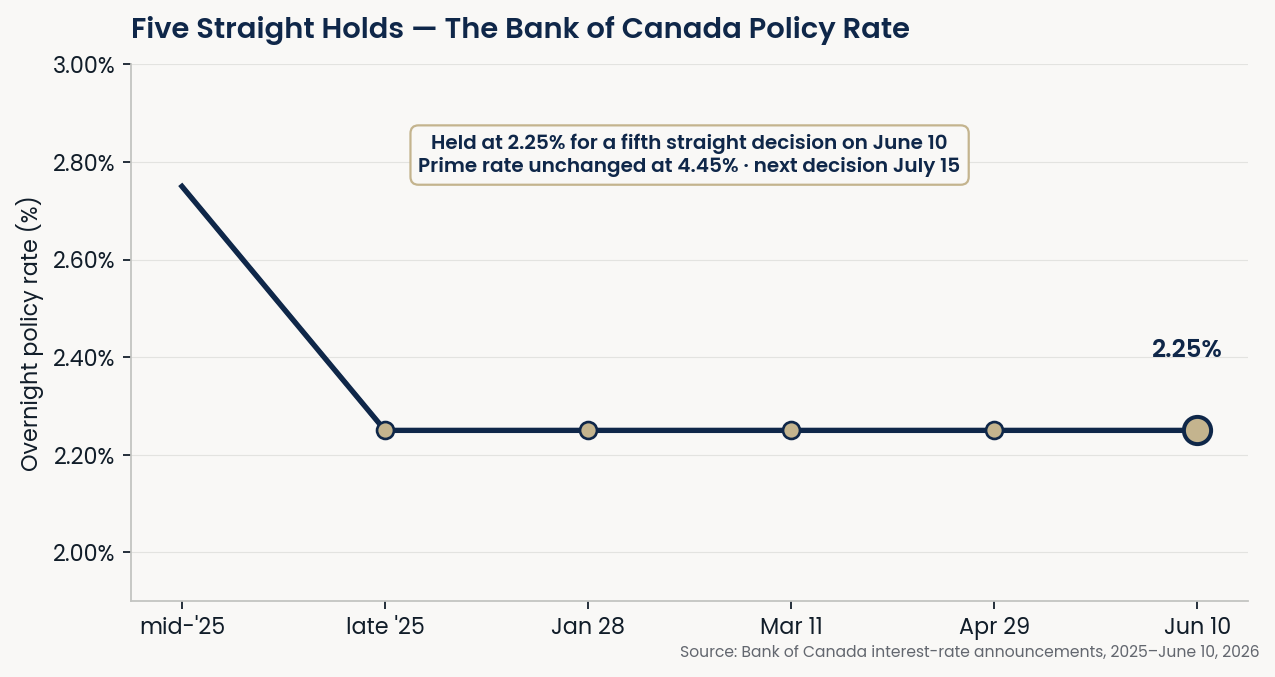
On Wednesday, June 10, the Bank of Canada held the overnight rate at 2.25% — the fifth decision in a row with no change, leaving prime at 4.45%. The Bank framed it as balancing two competing risks. On one side, the economy is soft: GDP actually edged down 0.1% in the first quarter, weaker than the Bank expected, and it sees the economy staying in "excess supply" even with a rebound coming. That weakness, on its own, argues for cutting.
On the other side sits inflation. Headline CPI ran at 2.8% in April, pushed up almost entirely by energy, with the Middle East conflict — now in its fourth month — keeping oil roughly $10 a barrel above the Bank's April assumptions. Strip out energy and the picture is far calmer: core inflation has eased back toward 2%. So the Bank is essentially saying it would like to cut to support a weak economy, but it won't while an oil-driven inflation scare is live. Governor Macklem kept the door open in both directions — a cut if U.S. trade restrictions bite, or even hikes if energy turns into broad, sticky inflation.
My read: this was a hold of caution, not conviction. The next decision is July 15, and the whole thing now hinges on one variable the Bank flagged itself — oil. Which is exactly what made the back half of the week so interesting.
2. The Oil Shock Reversed — and With It, the Rate Story
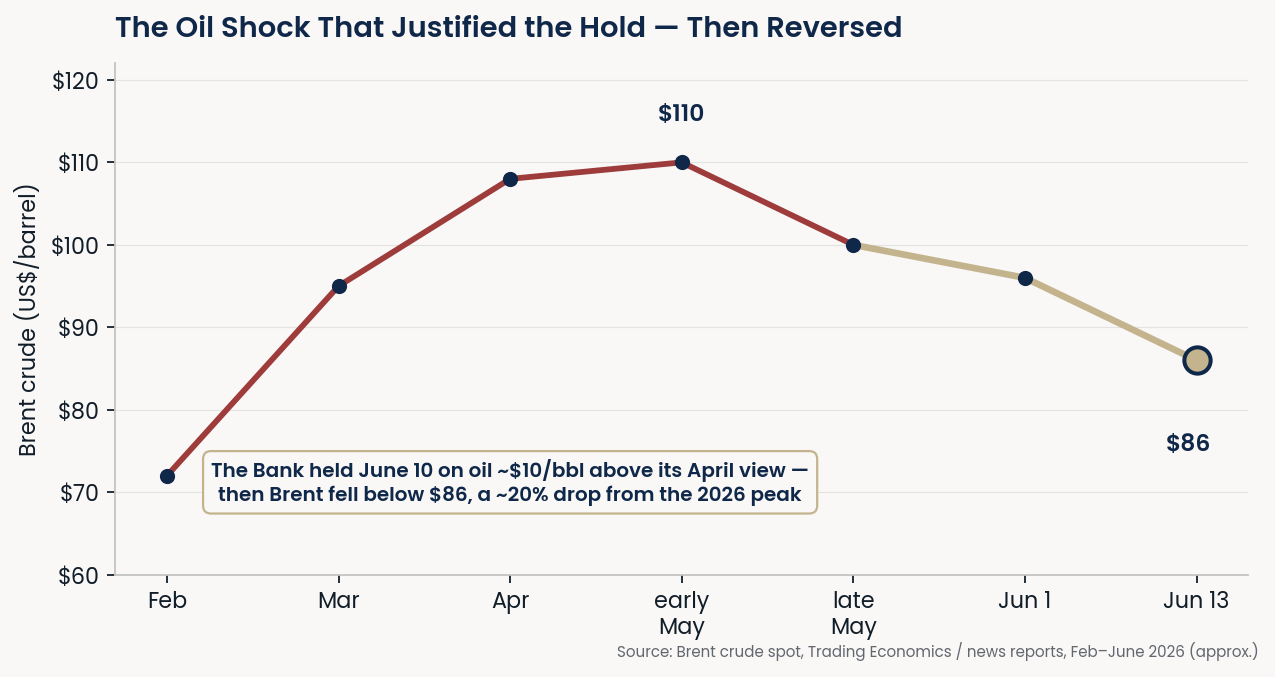
Here's the twist the Bank couldn't have scripted. The very oil premium it leaned on to justify holding started unwinding almost immediately — and as I write this on Sunday, it's accelerating. By Friday, Brent crude had dropped more than 4% to below US$86.50 a barrel — its lowest since early March, and roughly 20% below the 2026 peak. The catalyst: a concrete framework is now on the table. Iran's Mehr news agency reported a 14-point draft agreement that would lift oil sanctions and commit Tehran to reopening the Strait of Hormuz within 30 days, and President Trump said a deal could be signed as soon as this weekend in Europe. That's a world away from the roughly $110 peak that had the Bank worried just weeks earlier.
Why this matters for your mortgage: oil was the main thing standing between the Bank and a cut. If energy keeps cooling, headline inflation drifts back toward target, and the case for a July or fall rate cut comes back to life. It is genuinely not a done deal: the draft still needs Iranian sign-off, and even a signed agreement leaves real work before oil fully normalizes — clearing mines from the Strait, restarting idled fields, repairing damaged facilities. So treat the weekend headlines with a healthy pinch of salt. But the direction has clearly flipped, and that's the freshest, most market-moving signal on the board heading into July 15.
One important caveat for anyone shopping a mortgage right now: this helps variable rates more than fixed. Variable rates move with the Bank of Canada; fixed rates track government bond yields, which have stayed stubbornly elevated. That's why the best 5-year fixed is still hovering around 4.3% — the Big Six are advertising about 4.34% and sub-4% has basically vanished — while the best variable sits near 3.40%. If the oil-and-cut story plays out, the people who benefit first are the ones with variable-rate or upcoming renewals, not new five-year fixed locks.
3. Underneath the Rate Noise, GTA Prices Keep Firming
Step away from the macro and look at what the GTA market is actually doing, and the story is steadier than the rate-cut suspense suggests. The latest board data — TRREB's May report — showed sales up 6.3% year-over-year while new listings fell almost 19%. That's three straight months of demand rising into a supply that's starting to pull back, which is the textbook setup for a market that's quietly tightening.
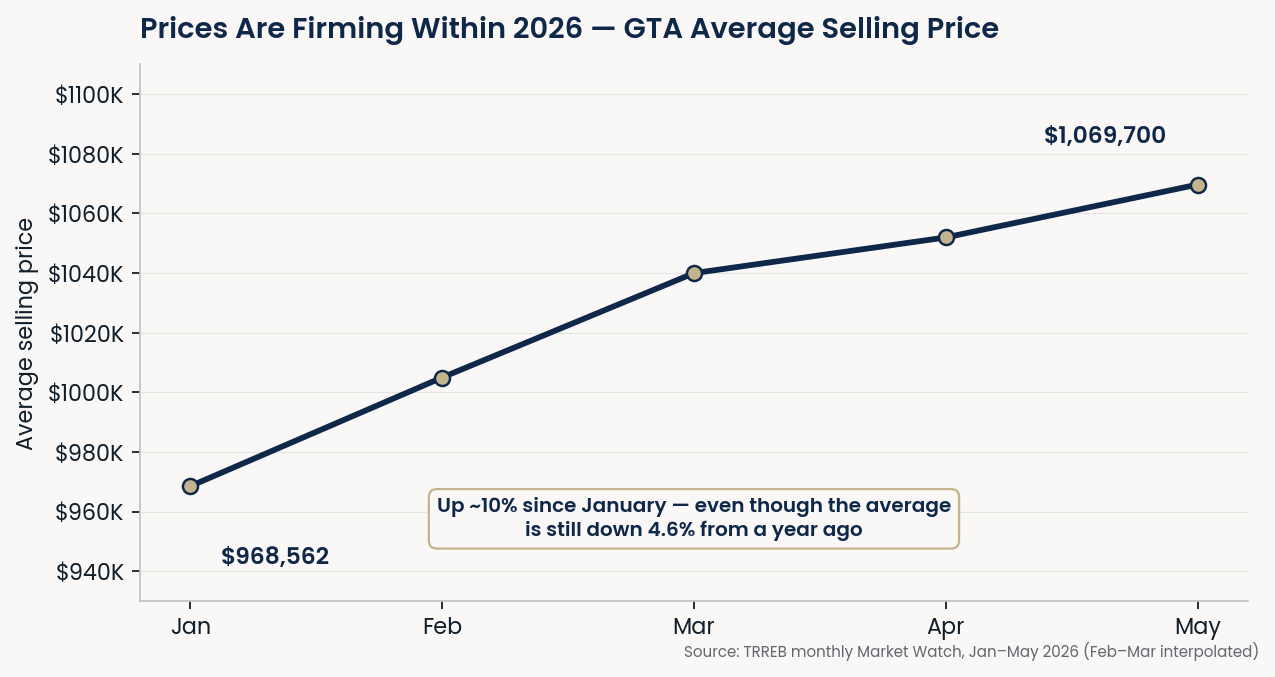
And while the year-over-year price number still looks negative — the May average of $1,069,700 was down 4.6% from a year ago — that's the wrong number to fixate on. Look at the path within 2026 instead: the average selling price has climbed from $968,562 in January to $1,069,700 in May — roughly a 10% rise in five months. On a seasonally-adjusted basis prices ticked up again month-over-month, and the sale-to-list ratio held at 98%. The negative annual figure is a comparison to a stronger early-2025; the in-year trend is a floor that's been firming since winter.
I'll keep this honest, the way the analysts I follow have — John Pasalis and Steve Saretsky among them have stayed deliberately cautious, and they're right to: trade-war uncertainty and a still-elevated backlog of inventory mean this is a gradual tightening, not a switch flipping to a seller's market. There are still plenty of homes to choose from. But the direction of travel — for freehold especially, across York Region — has been the same for a quarter now, and it favours sellers a little more each month.
4. The Condo Market Is Still Stuck on a Different Clock
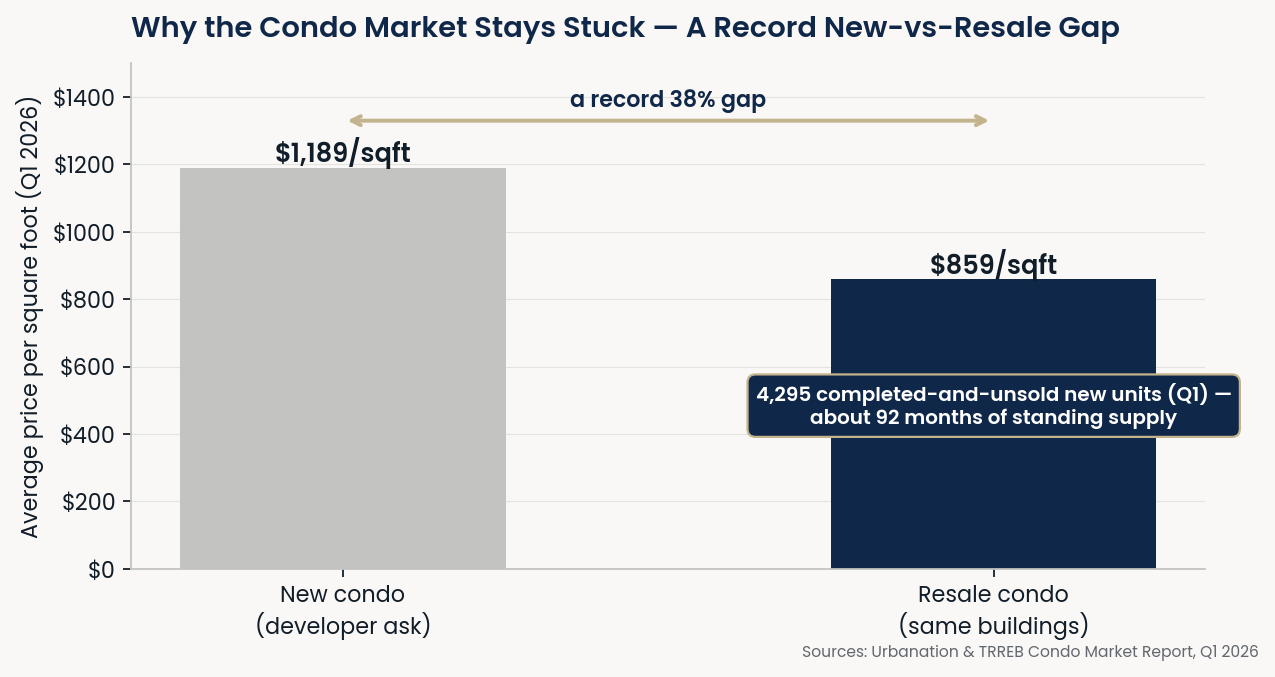
Now the other speed. While freehold firms up, the condo segment is still working through a glut. The thing holding it down isn't really resale demand — it's the wall of brand-new inventory behind it. A record 4,295 newly completed condos sat unsold as of the first quarter — roughly double a year ago and nearly five times the level of two years ago, which works out to something like 92 months of standing new-condo supply at the current pace. For the first time in at least 30 years, there were zero new project launches in the quarter.
Developers have cut asking prices on standing inventory to about $1,189 per square foot, but resale units in the same buildings are trading near $859 — a record 38% gap between new and resale. That gap is the whole problem: as long as a buyer can get the unit down the hall for a third less, the new stock can't clear, and builders won't launch. Industry watchers — Urbanation's team and Rates.ca among them — are framing the recovery as a slow grind that likely takes a couple of years, not a snap-back, even as rental demand and first-time buyers slowly chip away at the pile.
What it means: the condo correction and the freehold recovery are two different markets on two different clocks. For buyers, entry-level pricing in downtown Toronto and Scarborough condos hasn't been this negotiable in years. For sellers and investors, it's a reality check: a resale condo today competes directly with deeply discounted new supply, so pricing sharply on day one isn't optional.
Peter's Take
If you're buying
Don't wait for the Bank of Canada to ring a bell — by the time a cut lands, the freehold window will already be narrower than it is today. The buyer-friendly conditions of this year (lots of listings, patient sellers, conditions back in your favour) are slowly easing, especially for detached and townhomes in Markham, Richmond Hill, Stouffville and Newmarket. There's still real choice out there, so no need to panic — but the supply math is starting to work against the "wait for lower" bet on freehold. If you're shopping with a variable rate or a near-term renewal, the cooling-oil story is quietly on your side. And condos in downtown Toronto and Scarborough remain the genuine value play — real negotiating room against discounted new inventory. Get pre-approved on both fixed and variable, and lean on the last 30 days of comps.
If you're selling
Easing competition on the listing side is starting to work in your favour — but mostly in the freehold lane. A well-prepared detached or townhome in York Region is meeting a market that's firming, with somewhat fewer fresh rivals than earlier this spring; price it to meet the market on day one and you can ride that momentum. If you're selling a condo, the playbook is different — you're up against brand-new units selling below cost, so sharp pricing and standout presentation carry the day. In both lanes, time on market is still the enemy.
If you're investing
Let the two-speed market be your map. Freehold across the 905 is the sturdier long-hold thesis — land, scarcity and end-user demand, with supply now beginning to tighten. Pre-construction condos remain broken on cash flow and appraisal risk. But resale condos in the 416 and Scarborough at today's reset prices can finally pencil for a patient landlord with a real down payment— and if the Bank does start cutting later this year, today's negotiated entry looks even better in hindsight. Cap rates, not capital gains. Run the actual numbers before you commit.
The bottom line this week: the Bank held, as expected, but it told us exactly what it's watching — and within days that very thing started moving in the friendlier direction. Two near-term markers will tell us whether this is a real turn: CREA's national numbers land Tuesday, June 16, and the next Bank of Canada decision is July 15. Pair a possibly-reopening cut path with a GTA freehold market that's been firming since winter and a condo market handing buyers leverage, and you get a second half of 2026 with opportunity on both sides of the split. The clients who win it will be the ones who know which of the two markets they're actually standing in.
— Peter
Sources
• Bank of Canada — “Bank of Canada maintains the policy rate at 2¼%”, June 10, 2026 — https://www.bankofcanada.ca/2026/06/fad-press-release-2026-06-10/
• CBC News — “Bank of Canada keeps key interest rate at 2.25% as it tries to balance competing economic risks”, June 10, 2026 — https://www.cbc.ca/news/business/interest-rate-bank-of-canada-june-2026-9.7229759
• TD Economics — “Bank of Canada Interest Rate Announcement (June 10, 2026)” — https://economics.td.com/ca-boc-interest-rate-announcement
• Trading Economics — Brent crude spot (fell below US$86.50, lowest since early March), June 13, 2026 — https://tradingeconomics.com/commodity/brent-crude-oil
• CNBC — “Oil drops 20% from 2026 peak on optimism over U.S.–Iran ceasefire talks” (14-point draft, 30-day Hormuz reopening) — https://www.cnbc.com/2026/05/29/oil-prices-iran-ceasefire-us-trump-strait-hormuz-energy-costs.html
• CREA — next national statistics package scheduled for June 16, 2026 — https://stats.crea.ca/en-ca/
• Ratehub — Best 5-year fixed & variable mortgage rates, June 2026 — https://www.ratehub.ca/best-mortgage-rates
• nesto — “Mortgage Rates Forecast Canada 2026–2030” (bond yields, oil, fixed vs variable) — https://www.nesto.ca/mortgage-basics/mortgage-rates-forecast-canada/
• TRREB — “Spring Home Sales Stronger Than Last Year” (Market Watch, May 2026), June 3, 2026 — https://trreb.ca/market-data/market-watch/
• Move Smartly (John Pasalis) — Toronto real estate data & monthly market commentary, June 2026 — https://www.movesmartly.com/articles
• Real Estate Magazine — Daniel Foch on the GTA tightening and 2026 market risks — https://realestatemagazine.ca/foch-trrebs-2026-outlook-underestimates-growing-market-risks/
• Urbanation — “Standing Condo Inventory Hits Record High in Q1” (4,295 unsold; new-vs-resale gap) — https://www.urbanation.ca/news/standing-condo-inventory-hits-record-high-q1
• Global News — “Toronto condo market to recover ‘slowly,’ but it will take a ‘couple of years’: experts”, 2026 — https://globalnews.ca/news/11810785/toronto-condo-market-recovery/
• Canadian Mortgage Professional — “Toronto’s condo market hits rock bottom as unsold units pile up” — https://www.mpamag.com/ca/mortgage-industry/market-updates/torontos-condo-market-hits-rock-bottom-as-unsold-units-pile-up/572743
• WOWA — Toronto Housing Market & Bank of Canada rate, June 2026 — https://wowa.ca/toronto-housing-market
Peter Kiriazopoulos*, Sales Representative · Kompass Realty Group
RE/MAX Ultimate Realty Inc., Brokerage — Independently Owned and Operated
1739 Bayview Avenue, Toronto, ON · 416-721-2298 · [email protected] · kompassrealtygroup.ca
*Personal Real Estate Corporation. Not intended to solicit buyers or sellers currently under contract. This brief is general market commentary, not financial advice.