
KOMPASS REALTY GROUP
Weekly GTA Housing Market Brief
A Recession Nobody Will Call, a Renewal Wave
Nobody Can Stop.
Sunday, May 31, 2026 · Peter Kiriazopoulos, Kompass Realty Group
−0.1% Q1 GDP (annualized) | 2.8% April inflation (CPI) | 77% new-condo investors cash-flow negative | 3.35% best 5-yr variable mortgage |
Welcome back. The headline of the week landed Friday morning, and it was a big one: Statistics Canada confirmed the economy contracted for a second straight quarter, which by the textbook definition puts the country in a technical recession. That word grabs attention — and it matters for housing — but the story underneath is more nuanced than the headline, and in a couple of ways it actually helps the GTA buyer.
Here's the frame I'd use for the week. The macro picture softened just as household-level stress is showing up in the data — mortgage delinquencies are climbing, the 2026 renewal wave is biting, and the math on new-build condo investing is broken. And yet, the GTA spring market has quietly held its footing. Buyers in Markham and Stouffville are still circling; sellers in Scarborough and Toronto are still trading. Let's walk through what's real, what's noise, and what it means for you.
1. Canada Is in a 'Technical Recession' — What That Actually Means
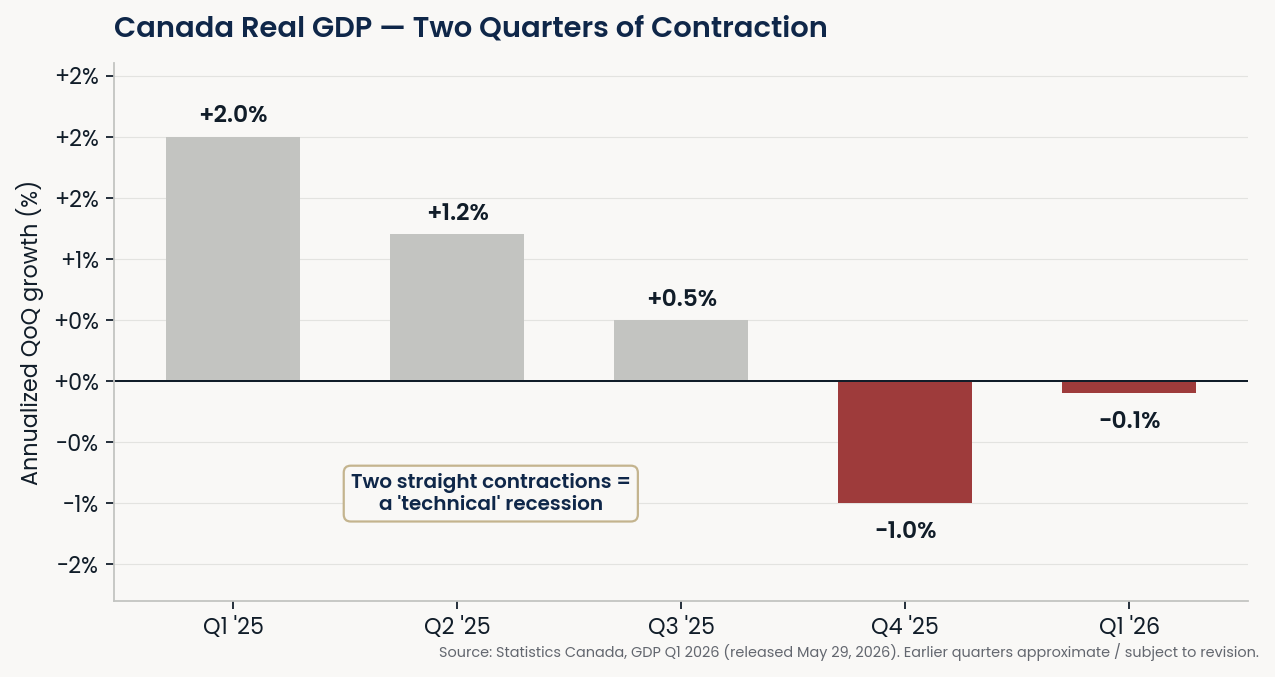
On Friday, May 29, StatCan reported that real GDP was flat quarter-over-quarter in Q1 2026 — which works out to a 0.1% annualized decline. Combined with a Q4 2025 number that was revised down to a 1% annualized drop, that's two consecutive quarterly contractions — the rule-of-thumb definition of a technical recession.
But read the fine print before you panic. On a per-capita basis, GDP actually rose 0.2% as the population shrank — and most of the headline weakness came from a surge in gold imports and a fifth straight quarterly drop in business investment tied to U.S. tariff uncertainty. Notably for us, StatCan singled out weak housing resale activity as one of the drags on the quarter. And the early read on April already points to a 0.4% rebound, so this may be a recession that's technically over before it was even announced.
“There will be plenty of debate over whether this constitutes a recession — we would say 'no, not really.'” — Doug Porter, Chief Economist, BMO — May 29, 2026 |
That's the consensus among economists: TD's Marc Ercolao said flatly “we wouldn't call it a technical recession,” and KPMG's Ali Jaffery cut to the point — “whatever you want to call it, it's not good.” The two-quarter rule ignores the labour market and income, which haven't collapsed. So the takeaway isn't “the sky is falling.” It's that the economy is stalled, not crashing — soft enough to keep a lid on interest rates, which is exactly the part that matters for your mortgage.
2. The Recession Boxes In the Bank of Canada — June 10 Preview
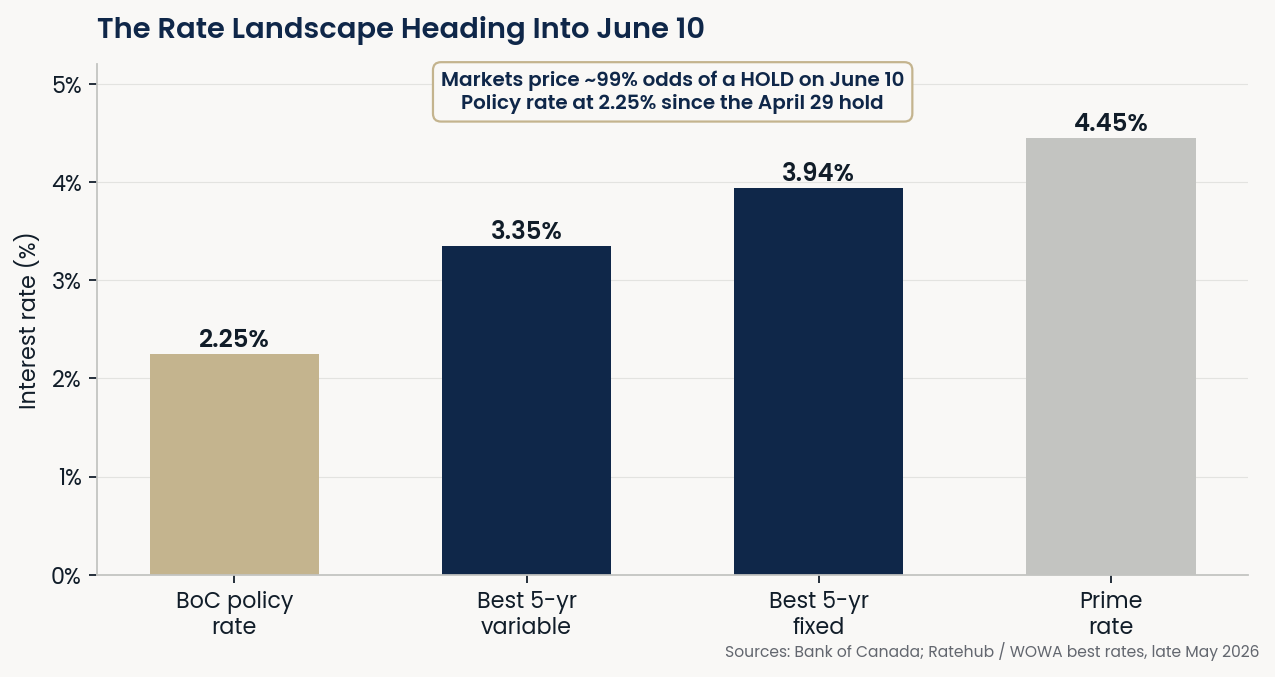
The Bank of Canada makes its next call on Wednesday, June 10, and bond markets are pricing roughly 99% odds of a hold at 2.25% — the fifth straight meeting with no change. A weak GDP print gives the Bank zero reason to hike. The complication is inflation: April CPI actually ticked up to 2.8% from 2.4%, even as core cooled to 2.1%. That's the box the Bank is in — a soft economy says cut, sticky headline inflation says wait.
For most of this spring the market narrative had drifted toward possible hikes. Friday's recession print quietly reopened the other door. If Q2 growth disappoints and inflation drifts back toward the Bank's 2.5%-by-June / 2%-by-early-2027 path, a cut later in 2026 is back on the table — not in June, but it's no longer off the menu. That's a meaningful shift from where heads were two weeks ago.
On the ground, the rate menu today: best 5-year fixed around 3.94%, best 5-year variable around 3.35%, prime at 4.45%. The fixed-variable spread has tightened to roughly 60 bps, and 42% of new applicants are now choosing variable — a bet that the next BoC move, whenever it comes, is more likely down than up. If you're financing a purchase or renewing this summer, get quoted on both and watch the June 10 statement language closely.
3. The Renewal Wave Bites: Delinquencies Are Climbing
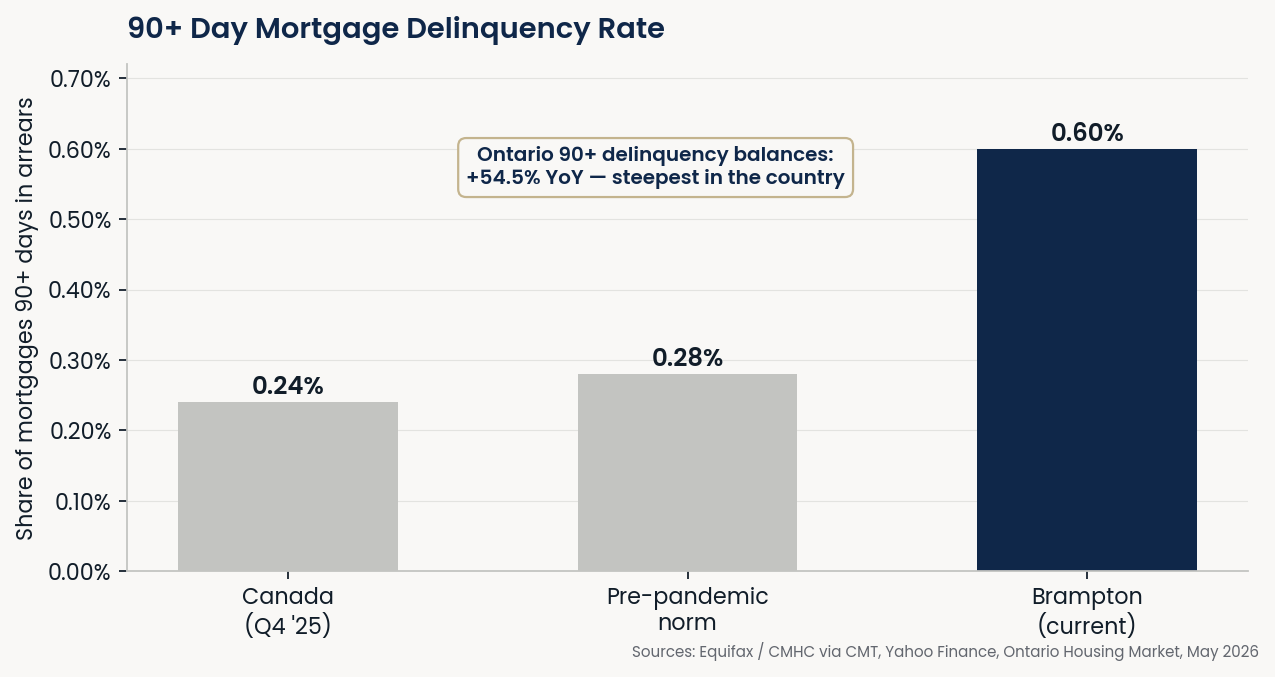
This is the household-stress story the recession headline overshadowed. Canada's 90-plus-day mortgage delinquency rate reached 0.24% in Q4 2025, up from 0.21% a year earlier — the highest since 2019 (though still under the 0.28% pre-pandemic norm). The more alarming figure is the rate of change: 90+ day delinquency balances jumped 30% nationally and a stunning 54.5% in Ontario year-over-year.
The epicentre is the 905. Brampton now has the highest mortgage delinquency rate in the country at roughly 0.60% — about three times the national average, and Toronto-area arrears have more than quadrupled from their post-pandemic lows. The driver is the renewal wave: roughly 1.15 million Canadian mortgages renew in 2026 alone, most of them resetting from rock-bottom 2021 rates to today's 4%-ish reality. OSFI flagged real estate as its #1 systemic risk earlier this spring for exactly this reason.
What it means for the GTA: distressed and motivated-seller listings will likely become a bigger share of inventory through the back half of 2026 — not a crash, but enough to pressure neighbourhood comps where a couple of forced sales close in quick succession. For buyers, that's where a patient, well-financed offer earns its keep. For owners with a 2026–27 renewal whose math doesn't work, the single most important thing is to start the conversation early — with your lender, a broker, and me — before the timing gets forced on you.
4. The Condo Investor Math Is Broken — and It's Getting Worse
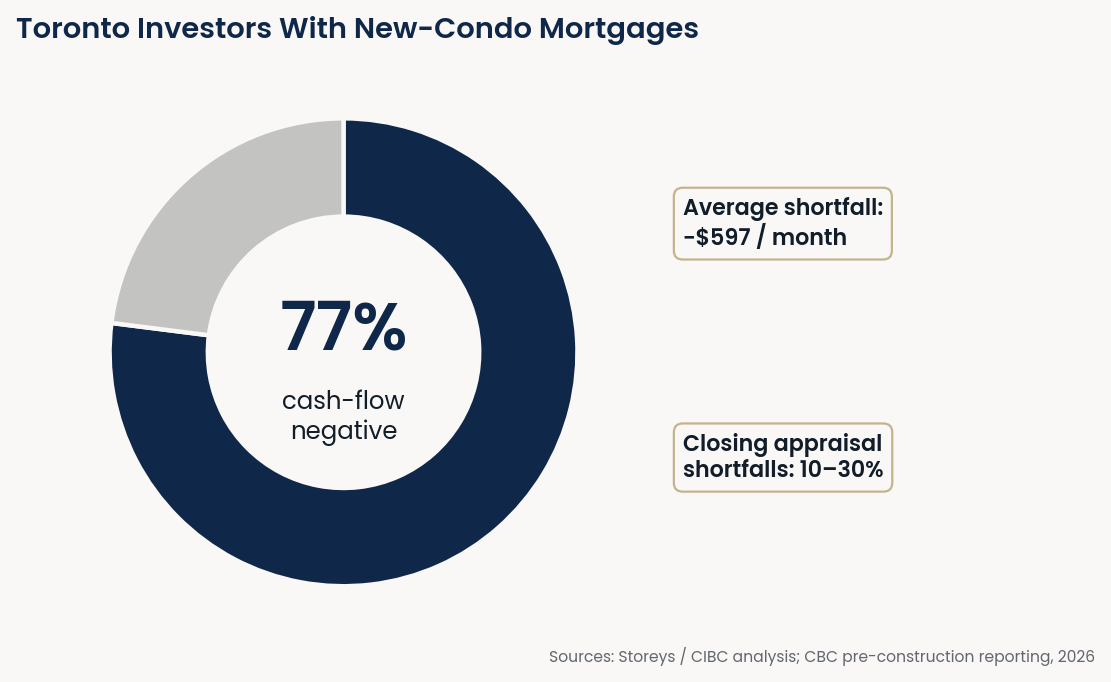
If you want to understand why Toronto's condo market is the weakest corner of the GTA, look at the investor. New data shows 77% of Toronto investors carrying a mortgage on a newly built condo are now cash-flow negative, bleeding an average of $597 every month. Rents aren't covering carrying costs, and they're not going to bail anyone out: GTHA rental vacancy hit 5.4% in Q1, with 66% of buildings offering incentives and 47% offering two months free, which has pushed effective rents down about 13%.
It gets harder at the closing table. With roughly 28,000 units completing across the GTA in 2026 and prices down 20–30% from the 2022 peak, appraisals are coming in 10–30% below the prices buyers signed for years ago, forcing investors to top up with cash they often don't have. The assignment market — the traditional escape hatch — has frozen to a level rarely seen outside a crisis.
The flip side is the opportunity. This is precisely the distress that institutional funds (High Art Capital and Jesta Group both announced nine-figure GTA condo buys this spring) are stepping into. For a retail buyer, the lesson is the same one the funds are acting on: the only condo math that works right now is cap rates, not capital gains. Resale units in downtown Toronto and Scarborough at today's pricing can finally pencil for a long-hold landlord with a real down payment. Pre-construction still does not. Know which game you're playing.
Peter's Take
If you're buying
Don't let the word “recession” freeze you — read what's underneath it. A stalled economy means rates stay put and may even start coming down later this year, which is good news for your financing. Meanwhile, household stress is putting motivated sellers into the market. That's a buyer's setup, especially in York Region and the Toronto/Scarborough condo segment where pricing has already done its correcting. Get pre-approved on both fixed and variable, do your homework on comps from the last 30 days, and use the conditions that are finally back in your favour. Patience plus financing wins this market.
If you're selling
The spring market is holding, but competition for buyers is getting sharper as the pool of motivated and stressed sellers grows. The homes that move in Markham, Stouffville, Scarborough, and downtown Toronto are the ones priced to meet the market on day one — not anchored to what a neighbour listed for last fall. Time on market is not your friend right now. And if you have a 2026–27 renewal looming and the numbers are tight, let's run them together now, while you still control the timing.
If you're investing
Cap rates, not capital gains — the institutional money is telling you the same thing out loud. Pre-construction condos are still broken on cash flow and appraisal risk; resale units in downtown Toronto and Scarborough at today's prices can work for a long-hold landlord with a 25–30% down payment. And the 905 freehold is a different, sturdier thesis altogether: land, scarcity, and end-user demand. Two very different games — just be honest about which one you're in.
The bottom line this week: the scariest word in the headlines — recession — is the one doing the least damage to the GTA market, while the quieter story of renewal stress is the one actually reshaping it. That combination keeps rates friendly and puts opportunity in front of prepared, patient buyers. Soft headlines, real openings. That's usually what the early innings of a turn look like.
— Peter
Sources
• BNN Bloomberg — “Canada slips into technical recession as economy stalls in Q1: StatCan”, May 29, 2026 — https://www.bnnbloomberg.ca/business/economics/2026/05/29/canada-slips-into-technical-recession-as-economy-stalls-in-q1-statcan/
• CBC News — “Canada slipped into a technical recession on an annualized basis”, May 29, 2026 — https://www.cbc.ca/news/business/recession-gdp-may-2026-statscan-9.7216352
• Statistics Canada — “Gross domestic product, income and expenditure, first quarter 2026”, May 29, 2026 — https://www150.statcan.gc.ca/n1/daily-quotidien/260529/dq260529a-eng.htm
• BOE Report — “Economists pour cold water on recession talk after Canada's economy stalls in Q1”, May 29, 2026 — https://boereport.com/2026/05/29/economists-pour-cold-water-on-recession-talk-after-canadas-economy-stalls-in-q1/
• Bank of Canada — Policy rate held at 2.25%, April 29, 2026 — https://www.bankofcanada.ca/2026/04/fad-press-release-2026-04-29/
• CREA — “Bank of Canada Holds Policy Rate at 2.25% for Fourth Consecutive Meeting” — https://www.crea.ca/media-hub/news/bank-of-canada-holds-policy-rate-at-2-25-for-fourth-consecutive-meeting/
• LowestRate Canada — “Why 42% of Canadians Are Going Variable in May 2026” — https://www.lowestratecanada.com/why-42-of-canadians-are-going-variable-in-may-2026/
• CMHC — “Mortgage renewal wave strains some regions and borrowers”, 2026 — https://www.cmhc-schl.gc.ca/observer/2026/mortgage-renewal-wave-strains-some-regions-borrowers
• Ontario Housing Market — “Brampton Now Has Canada's Highest Mortgage Delinquency Rate”, May 18, 2026 — https://ontariohousingmarket.com/2026/05/18/brampton-now-has-canadas-highest-mortgage-delinquency-rate/
• Yahoo Finance / Posthaste — “Mortgage delinquencies more than quadrupled in this Canadian city”, 2026 — https://ca.finance.yahoo.com/news/posthaste-mortgage-delinquencies-more-quadrupled-130001141.html
• Storeys — “Most Toronto Condo Investors Are Cash Flow Negative” — https://storeys.com/toronto-condo-investors-cash-flow/
• CBC News — “Pre-construction condo buyers face steep losses as Toronto prices slide” — https://www.cbc.ca/news/business/precon-condo-consequences-9.7103131
• CBC News — “Many Toronto-area rental units are sitting empty” (Urbanation Q1 vacancy data) — https://www.cbc.ca/news/canada/toronto/urbanation-vacancy-rate-rental-vacancy-first-quarter-this-year-9.7180713
• Ratehub / WOWA — Best Canadian mortgage rates, late May 2026 — https://www.ratehub.ca/mortgage-rates-toronto
• Zolo — Markham & Toronto market reports, May 2026 — https://www.zolo.ca/markham-real-estate/trends
• WOWA — Toronto & Canada housing market reports, May 2026 — https://wowa.ca/toronto-housing-market
• RE/MAX — York Region Housing Market Outlook 2026 — https://blog.remax.ca/york-region-housing-market-outlook/
Peter Kiriazopoulos*, Sales Representative · Kompass Realty Group
RE/MAX Ultimate Realty Inc., Brokerage — Independently Owned and Operated
1739 Bayview Avenue, Toronto, ON · 416-721-2298 · [email protected] · kompassrealtygroup.ca
*Personal Real Estate Corporation. Not intended to solicit buyers or sellers currently under contract. This brief is general market commentary, not financial advice.