

GTA Housing Market Update
March 15, 2026
If you’ve been on the fence about buying or selling this spring, you’re not alone. A lot of people are right there with you. The market is in a weird spot right now — and honestly, that’s kind of the story for 2026 so far.
Prices are softer. There’s more to choose from. But confidence is shaky, rates aren’t going anywhere fast, and the U.S. trade drama is making everyone a little nervous. Here’s what’s actually going on out there.
The Market Woke Up a Bit in February — But It’s Still a Buyer’s Game
After a really quiet January, we saw a decent jump in activity in February. Sales came in at 3,868 across the GTA — up 25% from the month before. That sounds exciting, but it’s still 4% below where we were last February, so let’s keep that in perspective.
The bigger picture: we have about 5 months of housing inventory sitting on the market right now. That puts buyers firmly in the driver’s seat. For comparison, a balanced market usually sits around 4 months of supply.
What are prices doing? The average GTA home sold for just over $1 million in February, down 7% from a year ago. Condos have taken the hardest hit — average condo prices are down nearly 9% year-over-year to around $627,000. Detached homes are down around 8% to $1.33 million.
The good news? Month over month, prices have been basically flat. Things may be finding a floor.
Here’s something else worth knowing: TRREB estimates there are over 100,000 buyers sitting on the sidelines right now, waiting for more certainty before they pull the trigger. That’s a lot of pent-up demand. When confidence returns — and it will — things could move quickly.
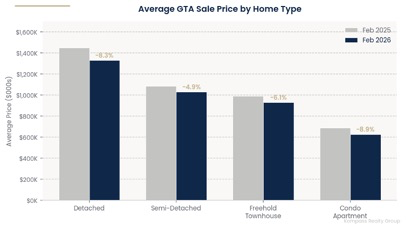
Average GTA sale price by home type — Feb 2025 vs Feb 2026. Gold % = year-over-year change.
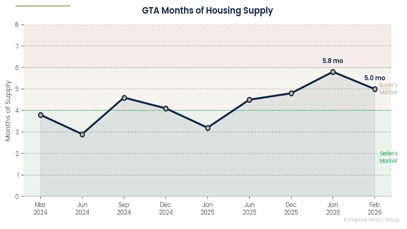
GTA months of housing supply — gold dots mark current readings. Buyer’s market = 4–6 months of supply.
Source: TRREB Market Watch
Source: WOWA Toronto Housing Market
The Pre-Construction Condo Market Is in Real Trouble
I don’t want to be alarmist, but the numbers in the new condo market are genuinely alarming.
New pre-construction condo sales across the Greater Toronto and Hamilton Area hit just 1,599 units in all of 2025. That’s a 34-year low. We’re talking 91% below the 10-year average. To put that in context, just four years ago at the peak, tens of thousands of units were selling every year.
On top of that, a record 28 condo projects were cancelled in 2025, wiping out over 7,200 units. Meanwhile, the number of completed but unsold condos more than doubled year-over-year.
If you bought pre-construction a few years ago and you’re closing this year, you may already know this story — a lot of those units are now worth less than what you agreed to pay. One mortgage broker called 2026 the most problematic year yet for pre-con closings, with about 28,000 units expected to register.
The longer-term concern? We’re barely starting anything new. Condo construction starts dropped 63% last year. Urbanation is now warning that the GTA could see virtually no new condo completions by the end of the decade. Today’s oversupply becomes tomorrow’s shortage.
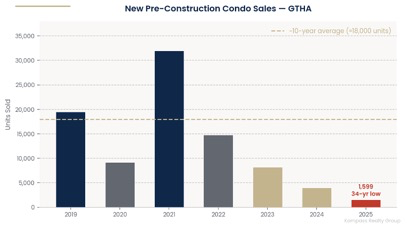
Annual new pre-construction condo sales in the GTHA, 2019–2025. Gold dashed line = approx. 10-year average.
Source: Urbanation via Storeys
Source: CBC — Pre-construction buyers face steep losses
The Bank of Canada Meets March 18 — Don’t Hold Your Breath for a Cut
The Bank of Canada makes its next rate announcement on March 18th, and pretty much every economist is expecting them to hold at 2.25%. Bond markets are pricing in less than a 10% chance of a cut.
The Bank is stuck between a rock and a hard place. The trade war with the U.S. is weighing on the economy, but rising oil prices tied to the conflict in the Middle East could push inflation back up. Cutting rates too early risks reigniting inflation. Holding too long risks tipping a sluggish economy into a real slowdown.
For homebuyers, this means the “I’m waiting for rates to drop” strategy has pretty much run its course. Most economists now see 2025’s rate cuts as the bottom. CMHC is projecting Canada’s economy to grow just 0.7% this year — one of the weakest years outside of an actual recession.
The bigger story in rates right now isn’t new buyers though — it’s renewals. About 1.15 million Canadians are renewing their mortgages this year, many of them rolling off the ultra-low 2% fixed rates they locked in during COVID. If you’re renewing onto today’s 5-year fixed rate of around 3.64%, you could be looking at monthly payment increases of $500–$600 or more. That’s real money, and it’s going to put real pressure on household budgets across the GTA.
Source: Ontario Housing Market — BoC Rate Forecast
Source: Bank of Canada January 2026 Statement
The Tariff Uncertainty Is Keeping Buyers on the Sidelines
You’ve probably noticed that housing market conversations keep coming back to one topic: what’s happening with the U.S. The trade war, and the upcoming review of CUSMA (the Canada-U.S.-Mexico Agreement) before July 1, is creating real uncertainty for everyday Canadians thinking about a major financial decision.
John Pasalis of Realosophy put it plainly: economic fear and uncertainty from the trade war could make a meaningful rebound unlikely for a while. Tom Storey told Toronto Life that buyers may have to wait years for things to improve.
The tariff impact on housing runs in two directions. On one hand, higher costs for steel, lumber, and building materials make new construction more expensive — limiting supply down the road. On the other hand, the fear of job losses is making buyers hesitant to take on a big mortgage right now.
The CUSMA review is the wildcard to watch. If negotiations go well and trade uncertainty eases before July, we could see a lot of that pent-up demand finally show up. If talks go sideways, expect the wait-and-see approach to continue well into 2027.
Source: Toronto Life — Tom Storey on Tariffs
Source: Global News
If You’re Renting, Right Now Might Be Your Best Moment in Years
Here’s a piece of genuinely good news for renters: the rental market has flipped dramatically. After years of insane competition, multiple applicants for every unit, and non-stop rent hikes, things are finally cooling down.
Vacancy rates in Toronto have climbed to around 3.1–3.7% — the highest they’ve been in years. Average asking rents for a two-bedroom are down about 4% year-over-year, landing around $2,720. That’s still not cheap, but it’s a meaningful pullback from the $2,920 peak we hit in late 2023. Nationally, average asking rents just hit a 33-month low.
A wave of purpose-built rental units that started construction a few years ago is now completing, flooding the market with new supply. At the same time, slower immigration, higher youth unemployment, and a general pullback in household formation have all softened demand.
The catch: this window is temporary. Purpose-built rental construction starts dropped 60% last year, which means this supply wave is already slowing down. By 2027 or 2028, we could be right back to a tight rental market. If you’re a renter looking to negotiate better terms or lock in a good deal, now is the time.
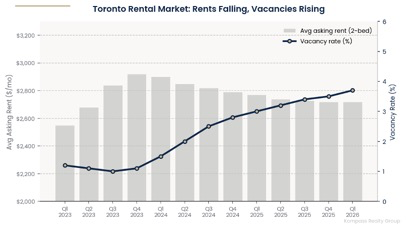
Toronto 2-bed asking rents (bars) vs. vacancy rate (navy line, gold dots), Q1 2023–Q1 2026.
Source: Urbanation — Rental Supply
Source: Rentals.ca National Rent Report
Bottom Line
Here’s what I think matters most heading into the spring market:
• Buyers have real leverage right now — more supply, lower prices, and less competition than we’ve seen in years. If your finances are in order, this is a better entry point than anything we’ve seen since 2019.
• If you bought pre-construction and you’re closing this year, get proper advice now. The gap between your purchase price and today’s market value is real and needs a plan.
• Don’t count on the Bank of Canada to give you a rate cut. The renewal math is going to be painful for a lot of households in 2026 — budget for it.
• Watch what happens with CUSMA before July 1. That outcome will do more for the second half of this year than anything the Bank of Canada does.
• Renters: use this moment. The leverage you have today won’t last — negotiate, lock in longer terms, and take advantage of incentives while they’re available.
This update was compiled from publicly available sources including TRREB, Urbanation, CMHC, CBC, Globe and Mail, Rentals.ca, and more. This is not financial or investment advice.