
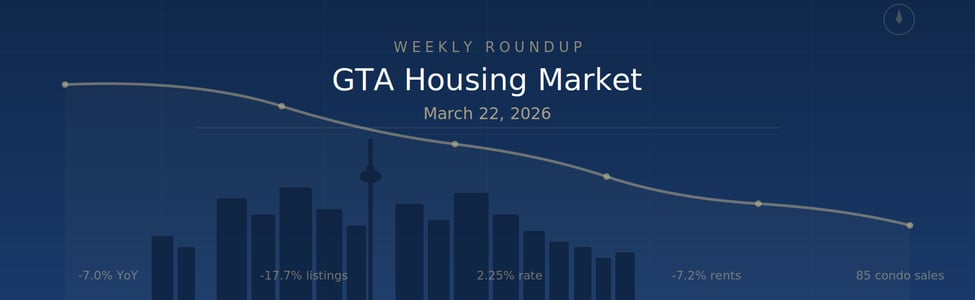
The GTA housing market heads into spring 2026 in an unusual position: buyers have the upper hand, but most of them aren't buying. With prices down across all property types, sellers pulling back, the condo market in genuine crisis, and U.S. tariffs hanging over the broader economy, the dominant mood is one of cautious wait-and-see. Here's what moved the needle this week. Whether you're watching the market in Stouffville, Markham, Richmond Hill, or anywhere across the GTA, the signals this week are worth paying close attention to.
Sellers Are Blinking First
The most underreported story in the March data may be this: sellers are retreating faster than buyers. New listings in February 2026 fell 17.7% year-over-year — a dramatic pullback that's tightening what had been a deeply oversupplied market. Active listings are essentially flat year-over-year at 19,314 units, and the sales-to-new-listings ratio sits at 36.1% — still technically a buyer's market (balanced is above 40%), but closing in.
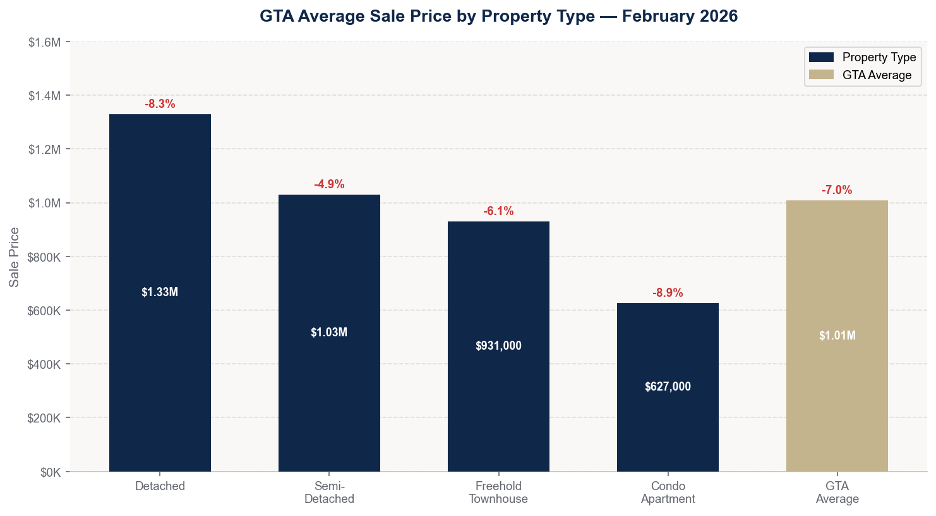
Prices remain under pressure. The GTA average hit $1,008,968 in February, down 7.0% year-over-year, with the MLS HPI benchmark falling 7.9% to $938,800. Condos are the hardest hit at -8.9% year-over-year ($627K average), with detached homes close behind at -8.3% ($1.33M). For the first time this decade, buyers are negotiating an average of 3% below asking — the sale-to-list ratio is sitting at 97%.
TRREB president Daniel Steinfeld estimates over 100,000 buyers are sitting on the sidelines waiting for prices to "level off." If listings continue to fall through spring, that pent-up demand could finally start converting. John Pasalis of Realosophy flagged the new listings trend as one of the most important signals to watch heading into the busy season.
In communities like Stouffville, Aurora, and Newmarket, where freehold townhouses and semis have historically attracted strong family-buyer demand, that pent-up pool of sidelined buyers is especially significant.
Sources: TRREB Market Watch (trreb.ca) | Move Smartly (movesmartly.com)
The Condo Crisis Deepens
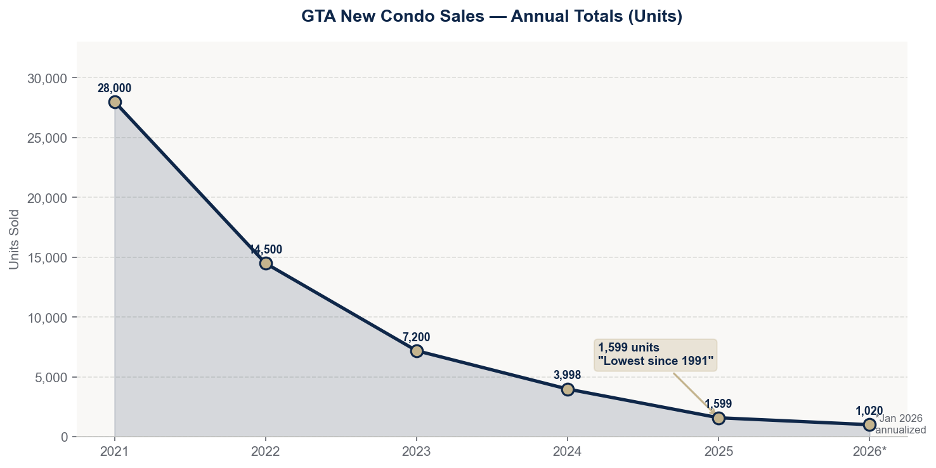
If there's one segment of the market that deserves the word "crisis" without exaggeration, it's pre-construction condos. New condo sales across all of 2025 totalled just 1,599 units — a 60% drop from 2024 and the lowest figure since 1991. January 2026 saw just 85 new condo units sold across the entire GTA.
The downstream effects are now impossible to ignore. Some 28 condo projects were cancelled in 2025, representing more than 7,000 units. Completed but unsold inventory has ballooned to 3,897 units — a 131% year-over-year increase and five times 2023 levels. Many pre-construction buyers cannot assign their contracts, leaving them holding deposits on properties worth less than their purchase price.
In suburban markets like Markham and Pickering, pre-construction assignments have become increasingly difficult to execute, with buyers unable to find qualified end-purchasers willing to step in at 2021 prices.
Developer insolvencies are picking up. The receivership of Mizrahi Developments' The One remains the highest-profile case, but smaller, less-capitalized builders are under widespread strain from carrying costs on stalled land and sites. RENX notes these woes are "likely to continue."
One notable policy response this week: High Art Capital and the Building Ontario Fund announced a $1.3B fund to acquire blocks of unsold completed condos and convert them to long-term rental housing, with the province providing up to $300M in mezzanine financing.
Dan Eisner, CEO of True North Mortgage, put it plainly: "I don't see a bottom yet."
Sources: CBC | Globe and Mail | RENX (renx.ca) | Storeys (storeys.com)
Bank of Canada Holds — But the Mortgage Renewal Wave Is Here
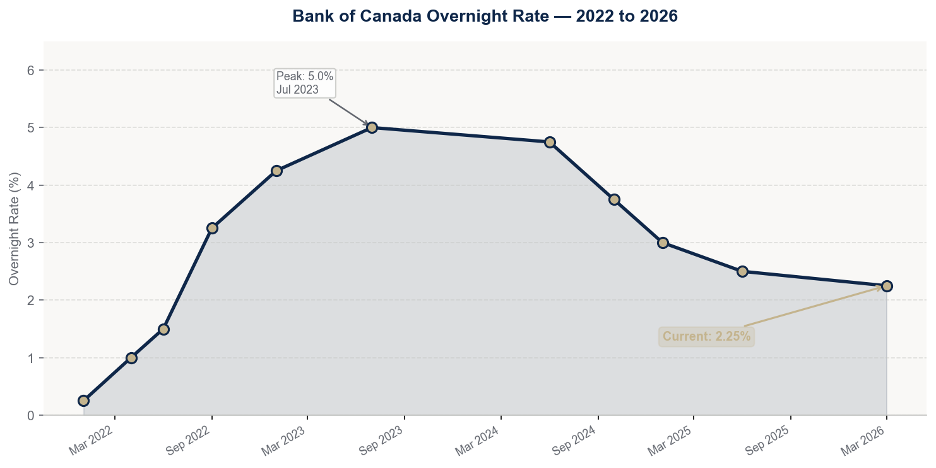
The Bank of Canada held its overnight rate at 2.25% on March 18, the second consecutive hold this year. Prime rate stays at 4.45%. Best available rates: 5-year fixed at 3.89%, 5-year variable at 3.45%.
The decision surprised few. Canada's GDP contracted 0.6% in Q4 2025, 84,000 jobs were lost in February, and inflation came in at 1.8% — below the 2% target. Markets are actually now pricing in a 75% chance of a rate hike by year-end, as bond yields creep up on geopolitical tensions and lingering inflation concerns related to tariffs.
The more immediate story is the mortgage renewal wave. Steve Saretsky notes that 2026 is the peak year for renewals, with the first half carrying the heaviest load — hundreds of thousands of households coming off sub-2% pandemic-era rates onto something closer to 4–5%. Ben Rabidoux of Edge Realty Analytics points out that mortgage delinquencies typically take 18–24 months after the first rate cut to peak, meaning stress in the system may not fully show up in the data until late 2026 or into 2027.
For homeowners across York Region and Durham Region — particularly in Whitchurch-Stouffville, Uxbridge, and Ajax — many of these renewals represent the first major payment adjustment since purchasing during the pandemic run-up.
The next Bank of Canada announcement is April 29.
Sources: MoneySense | Move Smartly — Ben Rabidoux Interview | Steve Saretsky Substack
Tariffs: The Biggest Wild Card in the Room
The trade war with the U.S. is now impossible to separate from any serious discussion of Canadian housing. Daniel Foch put it directly on BNN Bloomberg this week: "To understand the housing market in 2026 is to recognize that CUSMA is, in many ways, a housing story in disguise."
CMHC has warned that Canadian home prices could fall an additional 2% due to the trade conflict, with Ontario and BC bearing the brunt. TD Economics is forecasting GTA unemployment rising toward 7% as the region's labour market buckles. Fewer employed people means fewer qualified buyers, which compounds an already sluggish sales environment.
There was a brief moment of optimism when the U.S. House of Representatives voted 219-211 to repeal tariffs on Canadian goods in February — but Senate passage and a presidential signature remain far from certain. Mike Moffat of the Smart Prosperity Institute framed the stakes clearly: "If we're not able to export things, there's going to be job loss, there's going to be economic decline... You're going to have fewer people with the ability to buy homes, not unlike what we saw during the financial crisis of '08 and '09."
CREA's Shaun Cathcart was blunt: "In short order we've gone from a slam dunk rebound year to treading water at best."
Sources: CBC | Storeys | CREA | BNN Bloomberg
The Rental Market Has Flipped to Tenants
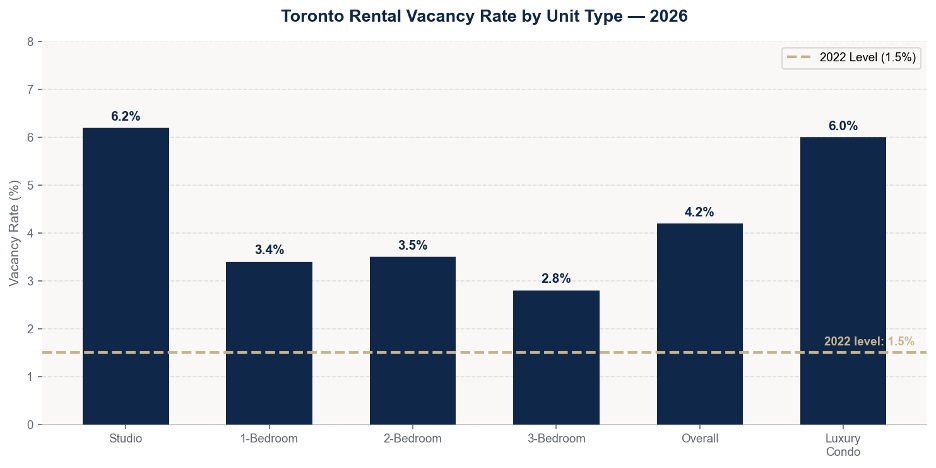
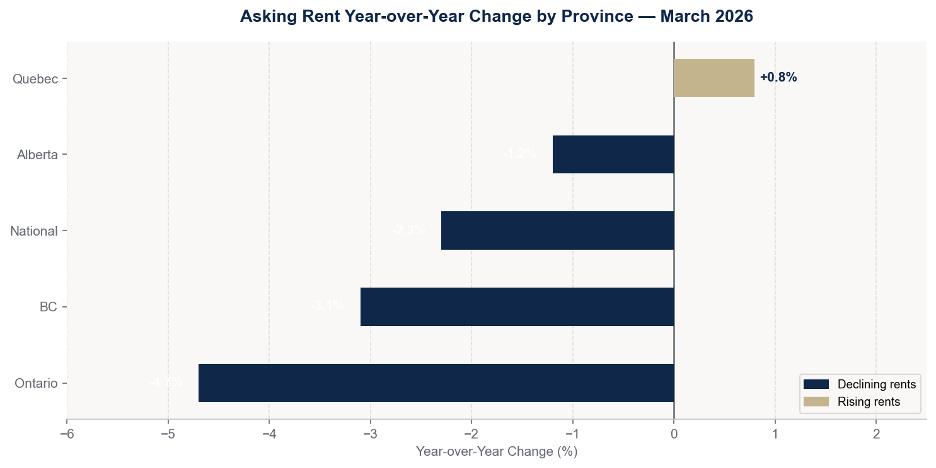
If you're a renter in Toronto right now, things look meaningfully better than they did two years ago. Ontario asking rents fell 4.7% year-over-year — the steepest provincial decline in the country — with Toronto specifically down 7.2% compared to January 2025. Two-bedroom apartments in Toronto are averaging $2,826/month. Nationally, asking rents sit at a 33-month low.
Two forces are driving this shift: a sharp pullback in immigration (permanent residents down from 483,000 in 2024 to 380,000 this year; international student visas slashed from 437,000 to 155,000), and a wave of new purpose-built rental completions arriving simultaneously. Ben Rabidoux notes that nearly 180,000 purpose-built rental units are under construction nationally — enough to expand the rental stock by 7%+ — and they're arriving just as population growth has decelerated sharply.
Toronto's overall rental vacancy rate is now at 4.2%, up dramatically from ~1.5% just a few years ago. Luxury condo-rental vacancy exceeds 6%. Some 63% of buildings are now offering incentives — one or two months free rent, free parking — up from 31% a year ago.
For landlords, the picture has reversed painfully fast. For tenants, it's the most leverage they've had in a decade.
In Markham and Richmond Hill, where a large proportion of the rental supply comes from investor-owned condos, landlords are facing especially stiff competition and are increasingly offering incentives to attract and retain tenants.
Sources: TRREB Rental Market Report | Urbanation (urbanation.ca) | Move Smartly — Ben Rabidoux
Key Takeaways • Sellers are retreating: New listings down 17.7% year-over-year is the most significant supply-side shift in over a year. The buyer's market could tighten faster than most expect — but it's not there yet. • The condo crisis is structural, not cyclical. Historic low sales, rising cancellations, and developer insolvencies suggest resolution is years away. Pre-construction buyers should get independent legal advice. • The Bank of Canada is on hold, but the mortgage renewal wave is the real story. Over 1 million households renewing in 2026 — many from sub-2% rates. Payment shock is real. • Tariffs are the dominant macro risk. Job losses in Ontario directly reduce the pool of qualified buyers. Watch unemployment data — it may matter more than interest rates in 2026. • Renters have leverage they haven't had in years. If you're coming up for renewal, negotiate hard. Vacancy is rising and landlords are competing for tenants. |
About Kompass Realty Group
Kompass Realty Group serves buyers, sellers, and investors across the Greater Toronto Area — from Stouffville and Uxbridge to Markham, Richmond Hill, Aurora, Newmarket, and Scarborough, Toronto. If you have questions about what this week’s market data means for your home, your investment, or your next move, our team is here to help. Visit us at kompassrealtygroup.ca or reach out directly to start the conversation.